
A solar combiner box is the enclosure where several photovoltaic strings meet and become one output headed for the inverter. It is a wiring and protection point, not a second inverter and not a place to invent fuse sizes. Inside a typical combiner you may find string fuses or breakers, a disconnect, and sometimes a surge protective device. Those parts are not synonyms. A fuse protects a conductor against too much current. A disconnect is how a qualified person isolates the circuit. A surge protective device limits a voltage spike. Putting all three words on one label does not make them one device.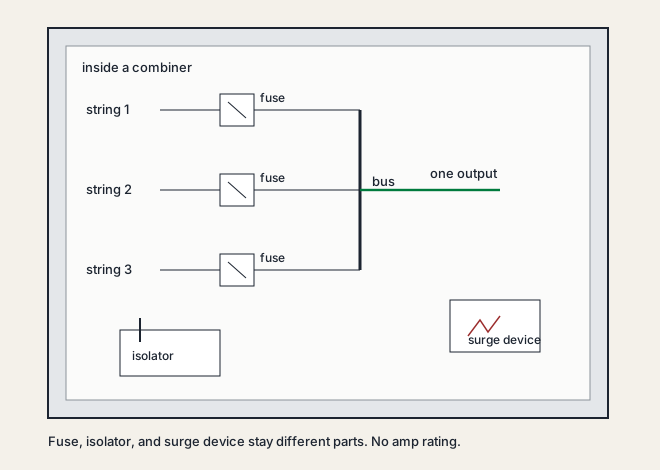
What a solar combiner box is for
Strings are series-wired modules. Their voltages add. Their currents do not. When you place several strings side by side, the currents add in the wire that leaves the combiner, and a fault in one string can be fed by the others. Overcurrent protection on each string, when the design requires it, is there so that backfeed does not cook a wire. The fuse rating comes from the module’s series-fuse rating and from the wire, in the calculation the electrical rules at the site require. This page does not print an amp number. A number copied from a different module is how the wrong fuse gets installed.
Not every array has a combiner box as a separate product. A string inverter with several fused inputs is doing the combining inside the inverter. A microinverter system often has no DC combiner of strings at all, because the module-level AC is combined on the AC side. The architecture choice is in string inverter versus microinverter. If your inverter already accepts the strings, adding an extra combiner because a diagram from a larger plant showed one is how people create joints they did not need.
What a string is, electrically, is in what a solar string is. The combiner does not change that definition. It only gives the strings a place to land.
Fuse, isolator, surge device, and breaker
A fuse is not a switch you open under load as a daily habit, and it is not a lightning protector. If the box includes a Type 2 surge protective device, that device has its own rating, and the rating is not a universal recommendation for every site. Lightning protection for an array is a design done with the building’s protection, not a fuse upgrade. The principle, without a recipe of kiloamperes, is in lightning protection for a solar array.
A disconnect in the combiner is part of isolation. Pacific Northwest National Laboratory describes emergency shutdown as the AC disconnect and then the DC disconnect, and it says disconnects are expected within sight of the inverter in the practices it discusses. A combiner on a roof that nobody can reach is a poor place for the only DC disconnect. Access is a design input. Who may open it is a trained person. Modules are live in daylight even when the inverter is off.
The box is not the place to fix a cold-voltage mistake. If the series string is already above the inverter’s maximum on a cold morning, combining it with other strings does not lower that voltage. Parallel strings add current. They do not average the voltage down. The cold check is in why cold weather raises solar voltage.
What to look at on the nameplate
| Marking | Question it answers |
|---|---|
| Maximum voltage | Is it at or above the cold open-circuit voltage of the strings, and consistent with the module’s maximum system voltage? |
| Number of inputs and current per input | Does it match the strings you have, with the fuse or breaker the design calculated, not a larger one “for headroom”? |
| Output current | Can the leaving conductor and the inverter input carry the added string currents? |
| Enclosure rating | Is it suitable for the roof or the ground where it will sit, in the wet and the sun? The rating on the box is the claim. A photo of a box is not. |
Grounding and bonding land here too, and they are not the surge device. Equipment grounding, bonding of metal parts, and a surge protector answer three different faults. This page will not lay out a ground rod. If the manual shows a grounding terminal, it gets the conductor the design specifies, landed by someone qualified. A painted box with a loose lug is a common reason a fault does not clear the way the drawings promised.
Monitoring can include string current at the combiner, which is how you see one open fuse without guessing from the daily total. A portal that only shows inverter energy will hide a single blown fuse inside the weather. What monitoring is for is in what a solar monitoring system is.
Frequently asked questions
Does every solar system need a combiner box?
No. You need a place where strings are paralleled and protected if you have multiple strings that must be combined before the inverter. An inverter with those inputs built in, or a microinverter system, may not have a separate DC combiner. Add a box when the design has a job for it.
Can I put a larger fuse in a solar combiner?
No. The fuse is sized to protect the wire and to respect the module’s series-fuse rating. A larger fuse keeps the inverter running through a fault the wire cannot carry. Headroom belongs in the design calculation, not in a swap at the box.
Is the combiner box the DC disconnect?
Only if it actually contains the disconnect the design relies on, and someone can reach it. Many combiners have string protection and a separate disconnect lives nearer the inverter. Read the drawing. Do not assume the box you can see is the isolation point.
Sources and references
Shutdown order, disconnects within sight of the inverter in the practices described, and live modules in daylight: Pacific Northwest National Laboratory. Surge protective devices as equipment that limits surge voltage, in the photovoltaic lightning technical report’s terms, are discussed at system-design level in IEC TR 63227:2020 preview. No fuse amp rating is stated. The rating is a calculation from the module datasheet and the conductor, under the rules of the site.
