
- Why cold weather raises solar voltage
- Where the higher voltage has to fit
- A check that uses the datasheet you have
- Frequently asked questions
- Do solar panels produce more voltage in cold weather?
- Is higher cold voltage the same as higher efficiency?
- Can I ignore this if I live in a warm climate?
- Sources and references
Cold weather raises the voltage of a solar module. The open-circuit voltage on the label is measured at a cell temperature of 25°C. A colder cell produces a higher open-circuit voltage, by the temperature coefficient of voltage printed for that module. Power can rise in the cold as well, which is the opposite of a hot afternoon, but the design hazard people miss is the voltage. A string that is comfortable in July can exceed the inverter or the charge controller on a bright January morning, before the equipment has loaded the modules down.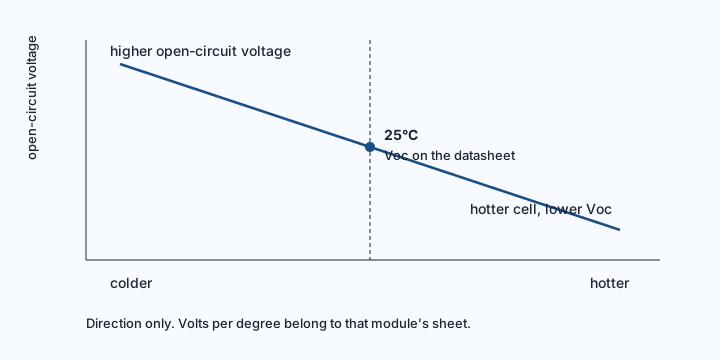
Why cold weather raises solar voltage
The label’s Voc is an open-circuit number at the standard test, not the highest voltage the module will ever make. Xcel Energy’s 2023 module requirements, for the crystalline modules that utility buys, ask the datasheet to include temperature coefficients. The coefficient of voltage is negative in the way manufacturers print it: volts fall as temperature rises, which means volts rise as temperature falls. The size of the coefficient is per module. Heterojunction, PERC, and thin film are not the same sheet. Do not paste one chemistry’s coefficient onto another. There is no universal volts-per-degree in this article.
The moment that matters is open circuit, cold, in sun. At dawn the inverter may not be tracking yet. The string voltage is the sum of the module open-circuit voltages at that cell temperature, not at 25°C and not the operating voltage you will see at noon. Series wiring is why the sum grows quickly. What a string is, and why the count is a calculation, is in what a solar string is. The MPPT window is a different line from the maximum input voltage. Tracking range does not protect you if the open-circuit voltage is already above the absolute maximum. How those lines differ is in what MPPT is.
Hot weather is the other direction and a different complaint. Power falls as the cell warms, at the power coefficient, and voltage falls with it. People who only watch July afternoons never see the January voltage peak. Both halves belong on the same datasheet. The power half is in how heat affects a solar module.
Where the higher voltage has to fit
It has to fit under the inverter’s maximum DC input. It has to fit under the charge controller’s maximum PV voltage, if the array charges a battery instead of feeding a grid-tied inverter. It has to fit under the module’s maximum system voltage, which is an insulation and listing limit, not a performance suggestion. Exceeding any one of those is a damaged device or a code problem, not a flattering “the panels are working extra hard.”
Record the temperature you designed for. “Cold” is the low ambient the site actually sees, translated to a cell temperature by the method the designer uses. A coastal site and a high inland site do not share a morning. Copying a string length from a mild catalog onto a mountain cabin is how the maximum is crossed. Winter installation does not cause the voltage rise. Winter reveals a string that was counted in shirt-sleeve weather. Crew and safety questions for that season are in installing solar panels in winter.
Snow changes the picture without canceling the rule. A module covered in snow may not be at high voltage, because it is not in the sun. A module that has just slid clear, still cold, in full sun, is the case the coefficient describes. Snow losses over a year are an energy question, in snow on solar panels. The voltage check is an electrical question on the clear cold morning after the snow leaves.
A check that uses the datasheet you have
| Step | Use |
|---|---|
| Start from Voc at STC | The open-circuit voltage on the module label, at 25°C, not Vmp. |
| Apply that module’s voltage coefficient | For the cold cell temperature you are designing to. Do not borrow a neighbor’s coefficient. |
| Multiply by the number in series | Voltages add in a string. Parallel strings do not add this voltage. They add current. |
| Compare with the limits | Inverter or controller maximum input, and the module’s maximum system voltage. All of them, not the most convenient one. |
If the cold sum is over the limit, remove a module from the series string or choose equipment with a higher maximum. Do not “hope the inverter starts fast enough.” The overvoltage exists before tracking begins. Do not replace the inverter with a larger AC kilowatt rating and keep the same maximum DC voltage. AC size and DC maximum are different lines. Overload on the AC side is a different problem: solar inverter overload.
This is also why a winter commissioning day is useful. A mild autumn startup does not prove the January margin. Logging the highest DC voltage the inverter records on a cold clear morning is a check of the design you already built. If that reading is against the maximum, treat it as urgent, not as a good-production day. Who may open the wiring remains a trained person. The modules are live.
Frequently asked questions
Do solar panels produce more voltage in cold weather?
Yes. Open-circuit voltage rises as cell temperature falls, at the coefficient on that module’s datasheet. The label voltage is at 25°C. It is not the cold-morning voltage.
Is higher cold voltage the same as higher efficiency?
No. Voltage is a design limit. Efficiency and power can also look better when the cell is cooler than the test temperature, and that is a power conversation. The hazard in this article is exceeding a maximum input, which a higher efficiency number does not excuse.
Can I ignore this if I live in a warm climate?
You can use a milder design temperature. You cannot skip the step. Early morning in the cool season is still colder than 25°C on many “warm” sites, and a string with no margin at STC has nowhere to go. Use the low temperature you can defend for that site.
Sources and references
Standard test conditions, including 25°C cell temperature: efficiency tables, version 68. A buyer’s requirement that the datasheet include temperature coefficients: Xcel Energy, November 2023. No numeric coefficient is printed here, because the coefficient is per module. Live DC work: Pacific Northwest National Laboratory.
