- What Does a Solar Monitoring System Measure?
- What Is Solar Performance Monitoring?
- How Does Solar Monitoring Software Raise an Alarm?
- What a Solar Monitoring System Does Not Do
- What Should a Solar PV Monitoring System Specify?
- Frequently asked questions
- Is a solar monitoring system the same as an off-grid battery monitor?
- What is solar performance monitoring for?
- Can satellite weather replace a sensor on the array?
- Sources and references
A solar monitoring system is a combination of hardware and software that tracks a photovoltaic system’s electricity production, operating conditions, and equipment status. It helps operators identify underperformance, investigate faults, and manage solar plant maintenance. The US Department of Energy’s federal energy management page puts the measurements in two groups: electrical quantities from the inverters or from added meters, and the sunlight and temperatures that explain them. A dashboard that shows only a daily kilowatt-hour total cannot tell a cloudy hour from a broken one.
Updated October 2026. This is photovoltaic system monitoring for a grid-connected array. A log of battery state of charge and generator hours, for a site with no utility, is a different instrument and is described in what off-grid solar monitoring has to show.
What Does a Solar Monitoring System Measure?
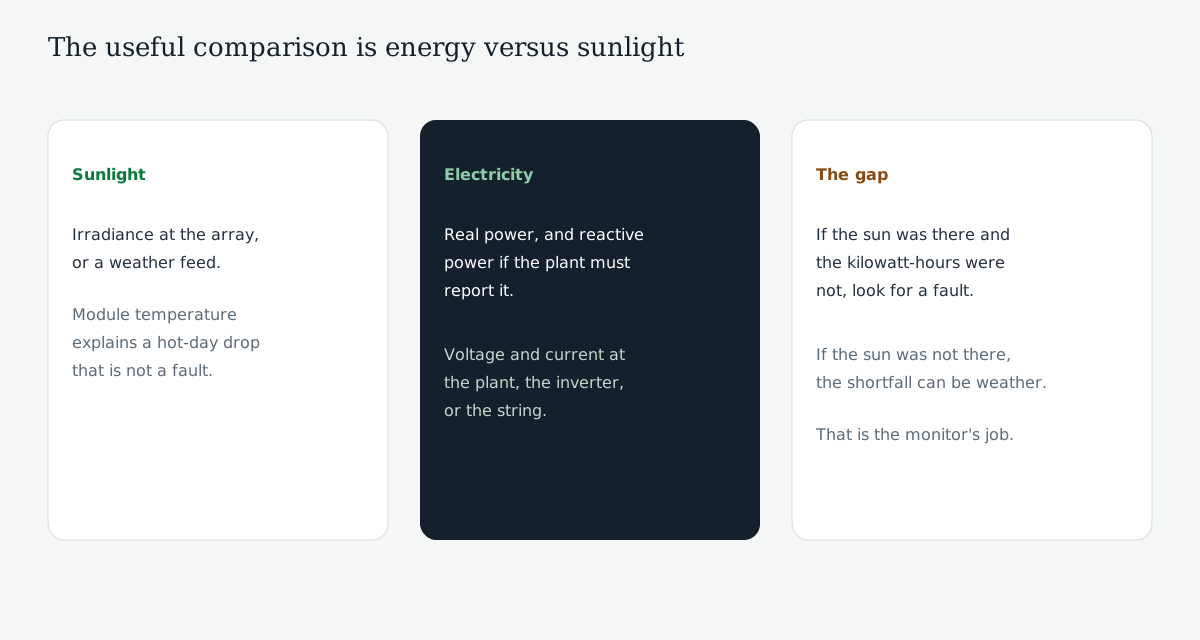
The Department of Energy lists real power, in kilowatts, and reactive power, in kilovolt-amperes reactive, for plants that need to report it. Those power readings are what a solar power monitoring system is built around. Voltage and current can be taken for the whole plant, for each inverter, for each string, or for each module. Finer metering finds a single weak string. Metering each module is a solar panel monitoring system: one panel at a time, at a higher cost, with more data to store. The useful question is which fault you are willing to miss until the next visit.
On the weather side the same page lists incident sunlight, ambient temperature, and module temperature. It also says weather data and satellite data are increasingly used instead of instruments on the site. That substitution is legitimate only if you know which feed the performance comparison uses. A satellite irradiance that does not see a local fog bank will make a healthy plant look broken, or the reverse. Module temperature matters because output falls as the cells heat, on a curve the module datasheet states. A hot, sunny afternoon can be a low-power hour without any failed connector.
What Is Solar Performance Monitoring?
The Department of Energy says a monitoring platform may compare the plant with neighbouring systems, or with a model built from the plant description and the environmental data. It names the System Advisor Model as one such model. Platforms may report availability and performance ratio, push those reports to the people who own the plant, and estimate bill savings from a tariff. They may also open a maintenance ticket and track it, and they may pass setpoints to and from a utility, including curtailment.
Performance ratio, in that usage, is a way of asking whether the energy delivered is reasonable for the sunlight and the plant that was built. It is not a marketing score, and it is not comparable across two plants that use different weather sources or different definitions. If the model still describes last year’s layout and the plant has since lost a string, the ratio will blame the weather for a configuration error. The Department of Energy notes that the documents — as-built drawings, the operations contract — belong with the data for that reason.
How Does Solar Monitoring Software Raise an Alarm?
The same page lists errors and alarms for abnormal conditions, by email or text. The useful alarm names the quantity and the time. “Inverter 3 offline since 10:40, irradiance normal” is a visit. “Fault” is not. Some corrective resets can be done remotely. NREL’s maintenance guide treats that remote step as part of corrective maintenance, and treats a site visit as what remains when the data say the loss is physical. The split between looking, comparing, and repairing is in photovoltaic power station maintenance.
Financial overlays — the value of lost production, a time-of-use credit — are only as good as the tariff entered into the platform. A wrong tariff turns an accurate energy measurement into a wrong invoice. Keep the kilowatt-hours as the primary record and the money as a calculation on top of them.
What a Solar Monitoring System Does Not Do
It does not wash a module, tighten a mount, or replace an inverter. It does not, by itself, tell you the battery’s state of charge on an off-grid site, because that site may not have the inverter metering this page assumes. It does not create a warranty. It supplies the production record a warranty claim will ask for, if the log was actually retained.
What Should a Solar PV Monitoring System Specify?
When you buy or specify a solar PV monitoring system, ask which quantities are stored, at what interval, for how long, and whether the store survives a lost network connection. Ask whether irradiance is measured on site or taken from a feed, and whether performance ratio uses that same feed. Ask who receives the alarm, and what the message contains. Those four answers decide whether the screen is a solar monitoring system or a picture of yesterday’s weather.
Frequently asked questions
Is a solar monitoring system the same as an off-grid battery monitor?
No. Plant monitoring, as the Department of Energy describes it, tracks power, energy, and the sunlight and temperatures that explain them. An off-grid monitor has to track battery state of charge and, where one exists, generator hours. A plant dashboard that has never seen a battery will not do that job.
What is solar performance monitoring for?
Solar performance monitoring compares delivered energy with what the plant and the weather should have produced. The Department of Energy describes that comparison as a model, or a comparison with neighbours, and lists performance ratio among the indicators a platform may report. Two plants are comparable only when the definition and the weather source match.
Can satellite weather replace a sensor on the array?
The Department of Energy says weather and satellite data are increasingly used instead of on-site measurements. The comparison is then only as local as that feed. Fog, a dirty sensor, or a feed that does not match the array’s horizon will mis-classify a normal hour as a fault, or hide a real one.
Sources and references
Measurements, weather substitution, performance comparison, alarms, tickets, and utility setpoints: Department of Energy, monitoring platforms for solar photovoltaic systems. How the resulting data feeds condition-based and corrective maintenance: NREL, photovoltaic operations and maintenance, 3rd edition, OSTI 1489002.
