- What bifacial solar panels add, and what they do not
- How the site decides whether bifacial solar panels pay
- What to ask for with bifacial solar panels
- Frequently asked questions
- Do bifacial solar panels make 30 percent more energy?
- Are bifacial solar panels worth it on a roof?
- Does the front nameplate include the rear?
- Sources and references
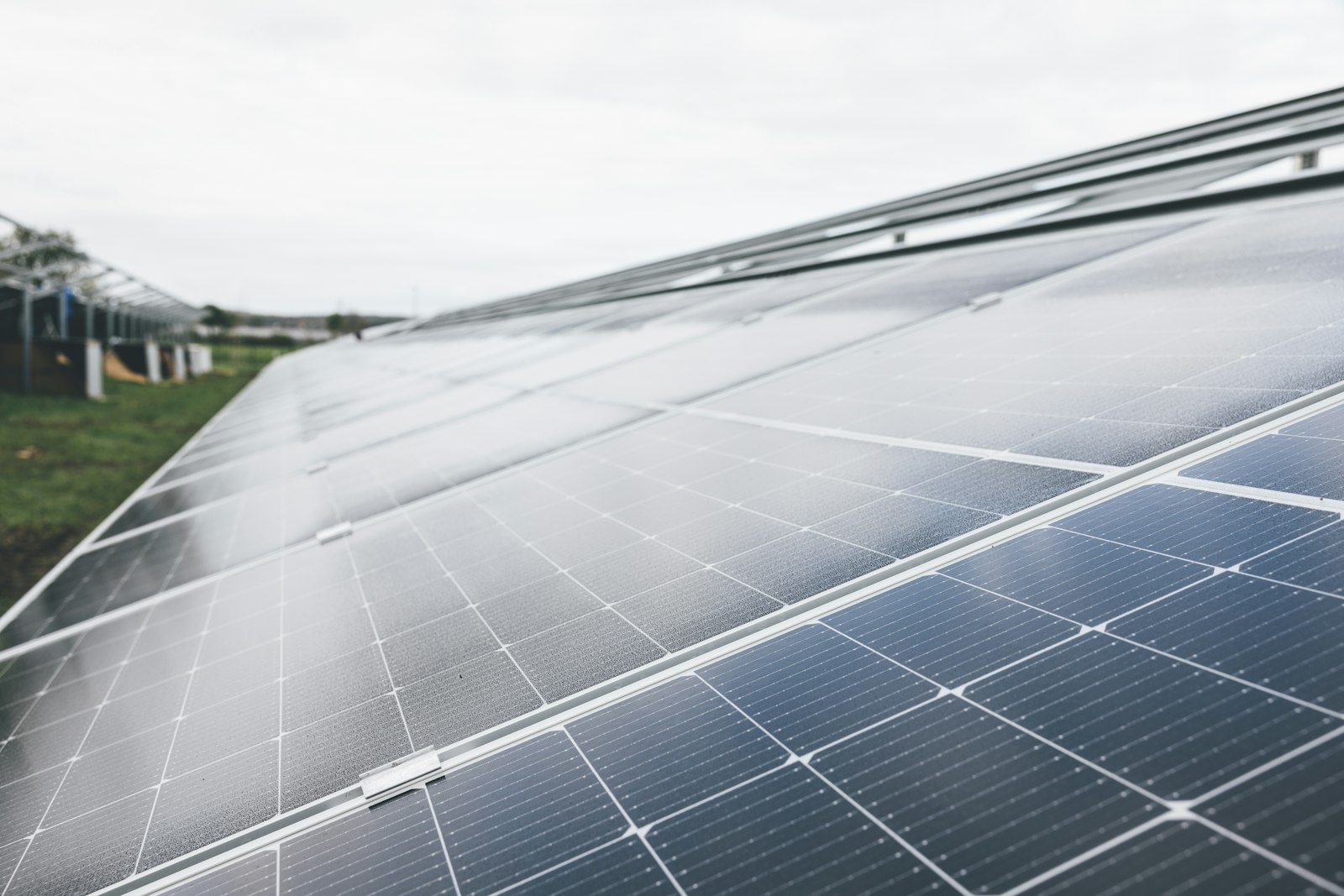
Bifacial solar panels collect light on the rear as well as the front. For an ordinary one-sided module, ground-reflected light is typically only about 1 to 2 percent of the irradiance the module sees, so a rough guess at the ground’s reflectivity is enough and often ignored. For a bifacial module the rear is part of the product. Albedo, the share of light the ground reflects, has to be a real measurement, not a single number pasted into a model for every month. NREL’s albedo primer makes that distinction the starting point. Albedo is not constant. It changes with the spectrum, the angle, cloud versus sun, and where the sun is.
What bifacial solar panels add, and what they do not
They do not add a fixed percentage to every plant. A NREL validation on a single-axis tracker reported about 6.5 percent annual bifacial energy gain for PERC modules and about 9 percent for silicon heterojunction modules. The slides say the gain depends on the site, the configuration, and the albedo. SAM and PVSyst looked conservative against the measured rear irradiance in that work. Conservative is not the same as wrong for your field, and that field is not your roof. A tight roof with a dark membrane behind the modules has less rear light than an open tracker row over pale ground.
Snow and vegetation change the rear more than they change a one-sided module. In the same NREL material, the spectral effect of snow was described as about 15 percent relative to brown winter grass, and green grass as greater than snow and about 10 percent relative to drier summer grass. Those are spectral effects in that discussion, not energy-gain percentages you can add to a bill. Do not turn them into “snow makes bifacial 15 percent better.” The energy gain remains the modeled or measured rear contribution for the array in front of you.
The cell still has to be built for a rear path. A PERC cell can be bifacial. A heterojunction cell can be bifacial. The module then needs a transparent or open rear, not a solid backsheet that blocks the light the cell could have used. The cell architectures are in what a PERC solar cell is and what heterojunction solar is. The word bifacial on a brochure does not specify the bifacial coefficient. Xcel Energy’s 2023 module requirements ask for that coefficient, with its tolerance, on the datasheet of bifacial modules the company buys, and they recommend that the power warranty cover the rear as well as the front. A warranty that only mentions the front is a one-sided promise on a two-sided product.
How the site decides whether bifacial solar panels pay
Height, row spacing, and the ground cover are the design variables. A row that shades the rear of the row behind it spends the bifacial hardware to buy a shaded back. Ground mounts and trackers are where this is easiest to get right, because you can choose the spacing. Roof mounts are where it is easiest to fool yourself, because the “ground” is a membrane a few centimeters away. The mount comparison, without repeating the bifacial arithmetic, is in roof-mounted versus ground-mounted solar.
Shade on the front still dominates. Bifacial solar panels do not cancel a tree. Diffuse and reflected light continue when the beam is blocked, and the rear adds another diffuse path, but a hard shadow on the front cells still pulls a series string. Module-level electronics can recover a portion of a shading loss, about 25 to 35 percent of that loss in NREL’s 2016 evaluation of the products it tested, and the larger difference was how many strings were in parallel. That recovery is not a bifacial bonus. Front shade is its own article: how shade affects PV output.
Tracking changes both the front and the time the rear sees the sky. The 6.5 and 9 percent figures above are from a tracker validation. A fixed tilt will not reproduce them by being bifacial. Fixed tilt does change snow. NREL’s snow model found fixed-tilt annual snow losses from about 0 to 16 percent across the continental United States for the designs it mapped, and sliding is the removal the model treats as dominant. Snow on the front blocks the front. Snow on the ground can raise albedo for the rear until it slides off the module or melts off the field. Those two snows are not one number. See snow on solar panels.
What to ask for with bifacial solar panels
| Ask | What a useful answer contains |
|---|---|
| Bifacial coefficient | A datasheet value with tolerance, not the word bifacial. |
| Rear warranty | Whether rear-side power is inside the performance warranty. Xcel recommends that it be, for modules they buy. |
| Albedo used in the model | A ground-specific figure, not a constant. NREL treats a constant albedo as the mistake one-sided design could afford. |
| Gain claimed | Tied to this layout. The 6.5 and 9 percent results are one tracker validation, not a default. |
Measure the rear if the gain is the reason you paid for the module. A front-only production meter cannot see it. Rear irradiance is a sensor problem, which is why the albedo primer talks about a ground-facing pyranometer as well as global horizontal irradiance. If nobody is measuring the rear, the bifacial line in the model is an assumption.
Frequently asked questions
Do bifacial solar panels make 30 percent more energy?
Not as a rule, and not in the NREL tracker validation cited here. That work reported about 6.5 percent annual bifacial gain for PERC and about 9 percent for silicon heterojunction, depending on configuration and albedo. A different site can land elsewhere. Ask for the albedo and the model, not a round bonus.
Are bifacial solar panels worth it on a roof?
Only if the rear actually sees light. A module a few centimeters off a dark roof has little albedo and little view of the sky from behind. Ground rows and trackers are the layouts where the NREL results were about. A roof quote should show the rear irradiance it assumed.
Does the front nameplate include the rear?
Read the datasheet. Front power at standard test conditions and the bifacial coefficient are different lines. Xcel’s buying rules ask for both. A single wattage that does not say which side it measured is not enough to compare two quotes.
Sources and references
Why one-sided modules can ignore albedo and bifacial modules cannot, including the typical 1 to 2 percent ground-reflected share: NREL albedo data for bifacial PV. Tracker validation gains of about 6.5 and 9 percent, and the spectral snow and grass notes: NREL bifacial field results. Rear-side warranty recommendation and bifacial coefficient on the datasheet: Xcel Energy, November 2023. Shading-loss recovery, which is not a bifacial gain: NREL, 2016.
