- What Are the Types of Photovoltaic Power Station Maintenance?
- How Often Should a Photovoltaic Power Station Be Cleaned?
- What Can a Photovoltaic Power Station Inspection See?
- Why Do Photovoltaic Power Station Maintenance Records Matter?
- Frequently asked questions
- Should a photovoltaic power station be washed every month?
- Who can repair a photovoltaic power station?
- Does monitoring replace photovoltaic power station maintenance?
- Sources and references
Photovoltaic power station maintenance is the work that keeps measured energy close to the energy the plant was built to produce. It is not a fixed monthly wash. The US National Renewable Energy Laboratory’s 2018 operations and maintenance guide splits the maintenance itself into administration, preventive work, corrective repair, and condition-based work that uses the data to decide when the first two should happen.
Updated October 2026. The guide is written for fielded photovoltaic plants and for plants that also include storage. A house with a few modules uses the same logic at a smaller scale. It does not inherit a utility plant’s staffing rules.
What Are the Types of Photovoltaic Power Station Maintenance?
| Type | What it actually is |
|---|---|
| Administration | Budgets, records, warranties, and a service log that still makes sense in year six. |
| Preventive | Scheduled work set by the equipment, the site, and the warranty. Dust, snow, pollen, and wildlife change the interval. |
| Corrective | Repair or replacement after something has failed. Some resets can be done remotely. The rest waits for a qualified visit. |
| Condition-based | The same tasks, triggered by the data logger instead of the calendar. NREL does not list them as a separate menu. |
Operations sit beside this list: safe procedures, monitoring, and the documents a new technician can find. NREL’s point is that a cheaper maintenance contract which skips the records does not make the plant cheaper. It makes the next failure harder to explain, and it can void a warranty that required the manufacturer’s interval.
How Often Should a Photovoltaic Power Station Be Cleaned?
Pacific Northwest National Laboratory’s operations page calls soiling the largest operations issue for photovoltaic systems, and notes that dirt is often hard to see. Their examples are the right kind of example: an array at a low tilt in a dry climate may need a summer wash every month, while an array at latitude tilt in a rainy climate may never need one. Those are illustrations of rainfall, tilt, and local air pollution. They are not a schedule to copy onto another site.
The same page says cleaning should follow the method the installer prescribed — water-fed pole, brush, mild detergent, or a washing machine — and that the manufacturer’s instructions override a generic checklist. Washing a module the wrong way, or walking on it, is how a maintenance visit creates the cracked cell it was meant to prevent. If production is in line with the season and with a clean reference, leave the glass alone.
What Can a Photovoltaic Power Station Inspection See?
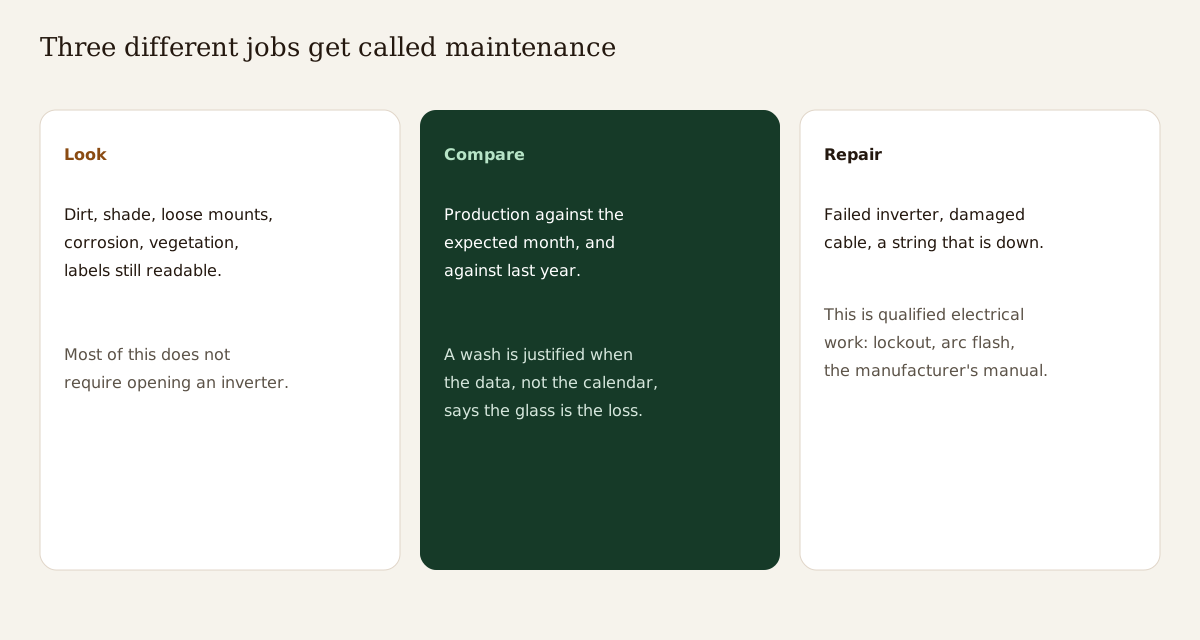
PNNL’s checklist is mostly looking: water inside equipment, signs of arcing, loose wiring, dirt and droppings, mounts that have moved, corrosion, roof penetrations, animals, vegetation, erosion, safety labels, and the monitoring gear itself. Inverters get a production check, a filter, fuses, and connections, on the manufacturer’s timing. A tracker, if the plant has one, follows its own manual.
That list is a prompt, not a licence. NREL’s guide treats arc flash, lockout, and rooftop access as conditions of the work, not as footnotes. A person who can see a dirty module is not automatically a person who should open a combiner or an inverter. Corrective electrical work belongs to someone qualified for that voltage, with the drawing and the shutdown procedure in hand.
Why Do Photovoltaic Power Station Maintenance Records Matter?
Both sources come back to the same object: a record of production, alarms, downtime, and what was done. Condition-based maintenance is impossible without it. A warranty claim is weaker without it. Comparing this month with the same month last year, and with the output the design model expected for that weather, is how a slow loss becomes visible before a string fails outright. How that comparison is built is covered in what a solar monitoring system is. Where the plant sits — a daytime load behind a meter, or a roof that only exports — changes which lost kilowatt-hour is expensive, which is the question in where a distributed plant fits.
Frequently asked questions
Should a photovoltaic power station be washed every month?
Only if soiling at that site is actually costing energy. PNNL’s examples run from monthly summer washes on a low-tilt array in a dry climate to never, where rain and tilt keep the glass clean. Follow the installer and the manufacturer, and use production data to decide.
Who can repair a photovoltaic power station?
Visual checks and recording production are widely treated as tasks for trained site staff. Opening inverters, replacing failed parts, and working where an arc flash is possible are qualified electrical work under the plant’s safety rules. NREL’s guide puts lockout and arc flash inside those rules.
Does monitoring replace photovoltaic power station maintenance?
It decides whether a visit is needed and what to bring. NREL calls that condition-based maintenance. It does not tighten a loose mount or wash a module. Someone still has to go when the data says the loss is physical.
Sources and references
NREL, Best Practices for Operation and Maintenance of Photovoltaic and Energy Storage Systems, 3rd edition, 2018: OSTI 1489002 and the PDF. The four maintenance types are in that guide. Soiling, wash examples, and the visual checklist: Pacific Northwest National Laboratory, solar photovoltaic O&M. The Department of Energy’s pointer to the same NREL guide: solar operations and maintenance resources.
