An off-grid solar system usually fails quietly for days before the lights go out. The battery ends each afternoon a little lower, the charge current no longer catches the night load, or the generator starts running on days when it used to sit. A monitoring system is worth paying for when it shows those three things in time to act, and when it keeps the record even if the mobile link dies.
Updated October 2026. Vendor dashboards promise fewer truck rolls. Treat any percentage like that as marketing until the site’s own log shows it.
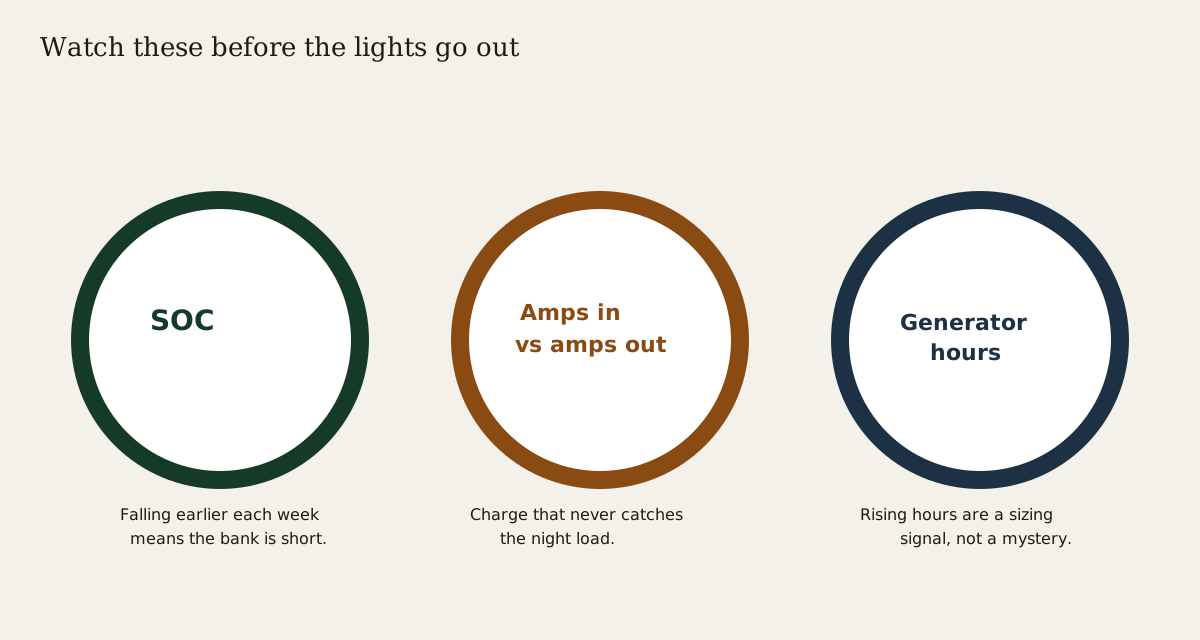
State of charge, read as a trend
A single voltage at noon is a weak clue. Lithium iron phosphate voltage is flat across much of the cycle, so voltage alone can look fine while the pack is half empty. The monitor needs a state-of-charge figure from the battery’s own meter, or from a shunt that has been counting ampere-hours, and it needs that figure at the same time each day. Dusk is the honest time. If dusk state of charge is 80%, then 70%, then 60% across a clear week, the array is not refilling the night load. The lights will still work. The failure has already started.
Lead-acid is the opposite problem. Voltage moves more, and a rested voltage can be read, but a voltage taken while the generator is charging tells you about the charger, not about last night. Write down which reading is which.
Amps in against amps out
The second record is current from the array and current to the loads, on the same clock. A site can show a full battery at 2pm and still be short, if the loads arrive after the array has faded and the morning recharge never catches up. Over a week, the area under “amps in” has to exceed the area under “amps out”, plus the losses, or the battery is the difference and it will shrink.
This is also how you catch a failed string. If noon current falls and nothing on the load side changed, the array is the suspect: a dirty module, a blown fuse, a connector, shade that grew with a tree. You do not need a weather satellite for that comparison. You need the two currents stored locally.
Generator hours are a sizing instrument
VeraSol’s off-grid guidelines treat a fuelled generator as part of a hybrid system, not as an embarrassment. The hours tell you which design you actually built. A generator that runs a handful of days in the worst month is covering the week the battery was not asked to cover. A generator that runs every evening is the supply, and the solar is a partial offset. Both can be acceptable. They are different bills for fuel, and different reasons to add modules.
Log runtime, and log why it started if the controller knows: low state of charge, a manual start, a failed inverter. An hour-counter that resets when the radio reboots is not a record.
The log has to outlive the link
Off-grid sites lose their uplink first. The tower is far, the SIM runs out of credit, the storm that flattens generation also flattens the signal. A gateway that only streams live values will show a blank exactly when you need the previous three days. The useful box stores the readings on site and sends them when the path returns. Store at least battery voltage or state of charge, array current, load current, and generator runtime. Panel voltage helps. A temperature in the battery room helps when a lithium pack has refused to charge in the cold.
Many inverters and charge controllers already expose these values on a local port, often as a register map for that model. The gateway has to use that model’s map. A generic “solar dashboard” that does not list the registers it reads will invent a state of charge or leave it blank. Local display still matters for the person standing in front of the cabinet with no phone service.
An alert is a reason to act before the visit
An alarm that says “battery low” after the lights are already out is a diary. Set the threshold at the state of charge where you still have a day to shed load or to send fuel, and send it by whatever path survives: SMS, a radio, a daily digest, a light on the enclosure. Include the value, not only the word alarm. “State of charge 35% at 18:00, generator did not start” is a decision. “Fault” is a plane ticket with no packing list.
Forecasts of sunshine can explain a low week. They do not replace the meter. If the forecast was sunny and the ampere-hours did not arrive, the equipment is the problem. If the forecast was cloud and the generator hours match that cloud, the system is doing what it was sized to do.
What to ask a monitoring proposal
- Which quantities are stored on site, and for how many days, when the uplink is down?
- Is state of charge measured by a shunt or a battery management system, or guessed from voltage?
- Are generator hours in the same log?
- What message arrives, to whom, at what threshold, while there is still time?
Further reading
Why a generator belongs in the design, and therefore in the log: VeraSol system installation guidelines (PDF). How the worst month sets the array those amps have to refill: living off grid through January.
