
Solar panel tilt is the angle between the module face and the horizontal. Orientation is the compass direction the module faces. Together they decide when the array sees the sun, how much snow and dirt it sheds, and whether a roof you already own is a good solar roof or merely a roof. There is no universal best angle. A latitude-tilt rule is a planning idea for annual energy on a clear site. It is not a code, and it is not what a south-facing house roof at 22 degrees is going to become unless you build a tilted rack and take the wind load that comes with it.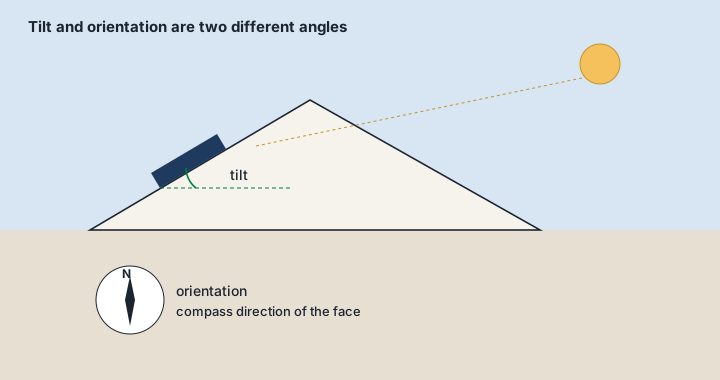
What tilt changes
A steeper tilt favors the lower sun of winter and sheds snow and rain more readily. A flatter tilt favors the high sun of summer and holds snow and dust. Fixed-tilt snow losses in a national model were about 0 to 16 percent of annual energy across the continental United States for the designs mapped, and higher at some Alaska sites. The tilt was part of those designs. A shallow roof in a snowy town is not the same loss as a steep roof in a rainy one. Snow behavior is in snow on solar panels. Soiling follows the same geometry. Pacific Northwest National Laboratory notes that a low-tilt array in a dry season may need washing on the order of monthly in summer, while a steeper array in a wet climate may never. That is an illustration, not a schedule you copy onto the wrong climate.
Annual energy for a fixed roof is what a weather-file model such as PVWatts estimates once you tell it the tilt and the azimuth you actually have. PNNL points people to PVWatts when the installer did not leave monthly figures. Changing the tilt in the model is how you see the trade. Changing it on the roof is a structural project. Winter production is not zero because the tilt is imperfect. It is lower, and the bills already know your winter. How installers work in that season, as a crew question rather than an energy myth, is in installing solar panels in winter.
Bifacial modules care about what the rear sees. Tilt and row spacing open or close that view. A one-sided module gets only a little from the ground, typically 1 to 2 percent of irradiance, so tilt for a monofacial array is mostly about the front. Bifacial gain is site-specific. One tracked validation is not your flat roof. Details are in bifacial solar panels.
What orientation changes
In the northern hemisphere, a south-facing array sees more annual sun than an east or west array on the same tilt, on an unshaded site. East and west move the production into the morning or the afternoon. That can match a family that is home at those hours, or a tariff that pays more late in the day, and it can be worse for annual kilowatt-hours. The southern hemisphere reverses the compass. A rule written for one hemisphere and pasted onto the other is a real mistake, not a rounding error.
The roof often removes the choice. Two faces, east and west, are a layout problem, not a reason to put both faces on one series string. A string shares current. Mixed orientations belong on separate MPPT inputs or on module-level electronics. Shade from a neighbor’s ridge can erase a “perfect” south azimuth for part of the year. Walk more than one month. Shade is in how shade affects PV output. String versus micro is in string inverter versus microinverter.
Trackers change tilt, or tilt and orientation, through the day. They add a mechanism that has to be maintained, and they are a ground-mount decision more often than a house-roof decision. What a tracker is, without pretending every roof should have one, is a separate question from accepting the roof you have. Ground versus roof, including access and structure, is in roof-mounted versus ground-mounted solar.
How to use tilt and orientation without a fake optimum
| Situation | What to do with the angle |
|---|---|
| A sloped roof in good condition | Use the roof’s tilt and azimuth in the production model. Do not rebuild the roof to hit latitude unless structure and wind were designed for a tilted rack. |
| A flat commercial roof | A low tilt is often a wind and ballast decision, not an energy optimum. Snow and dirt will sit longer. The structural letter comes first. |
| A ground mount you can aim | Latitude tilt is a reasonable starting point for annual energy. Steeper if winter and snow matter more. Model it. Do not copy a degree table from another country. |
| East-west roof, no south face | Model both faces. Keep them on separate trackers. An east-west layout can be the right project and still lose annual energy versus a clear south field. |
Before the rails go down, the roof has to carry the mount. Tilt is not a substitute for that check. What to settle first is in what to check before a rooftop solar installation. Production estimates also feed payback, and a model that uses the wrong tilt produces a confident wrong year. The arithmetic, without a fake payback, is in how a solar payback period is calculated.
Frequently asked questions
What is the best tilt for solar panels?
The tilt you can build, modeled for your weather file. Latitude tilt is a starting point for a ground mount aimed at annual energy. A house roof should usually keep its own slope. No single degree is the best tilt for every latitude and every season.
Do solar panels have to face south?
In the northern hemisphere, south typically wins on annual energy if the site is unshaded. East and west still work, and they shift the hours. Shade, roof direction, and the tariff can matter more than the compass ideal. In the southern hemisphere, face toward the equator, which is north.
Should I change the tilt every season?
Only if the mount was built to be adjusted and someone will actually adjust it safely. Most rooftop arrays are fixed. A seasonal adjustment is a ground-mount feature, and it is a maintenance task, not a requirement for solar to function.
Sources and references
PVWatts as the estimator when monthly figures were not provided, and soiling that depends on tilt and climate: Pacific Northwest National Laboratory. Fixed-tilt snow losses about 0 to 16 percent of annual energy in the continental United States for the designs modeled: NREL SAM snow model. Ground-reflected irradiance typically 1 to 2 percent for a monofacial module: NREL albedo primer. No universal optimum angle is stated.
