A distributed photovoltaic plant earns its keep when something nearby can use the electricity in the same hour the panels make it. A roof that generates at noon over an empty building is still a power station. It is a power station whose income depends on the export price, the local grid’s appetite, and whatever rule limits how much that connection may inject. The panel brand does not decide that.
Updated October 2026. The Chinese voltage and size limits below are from a September 2014 notice. They are not a world standard, and they are not a claim about today’s approval limits.
Size does not define it
IEA PVPS, in its 2026 trends report, treats distributed PV as systems that serve a grid-connected customer or feed the distribution network, very often on the customer’s side of the meter. The report is explicit that size is not what makes a system “distributed”. A 1 MW rooftop is large for PV and still ordinary as distributed generation. Countries do not even share a kilowatt cutoff. The report’s own split for new capacity in 2025 put the centralised segment at about 59% (410 GW) and the distributed segment at about 41% (282 GW), with off-grid volumes folded into distributed statistics because many countries barely count them.
On a building, the same report separates two products that get blurred in brochures. Building-applied PV is added to a roof or wall that already keeps the weather out. Building-integrated PV is a construction product: if you remove it, you have to put a roof or a façade back. A rack on a warehouse is the first. A glass roof that is the waterproof layer is the second. The electrical question underneath both is still who uses the kilowatt-hour.
The hour matters more than the postcode
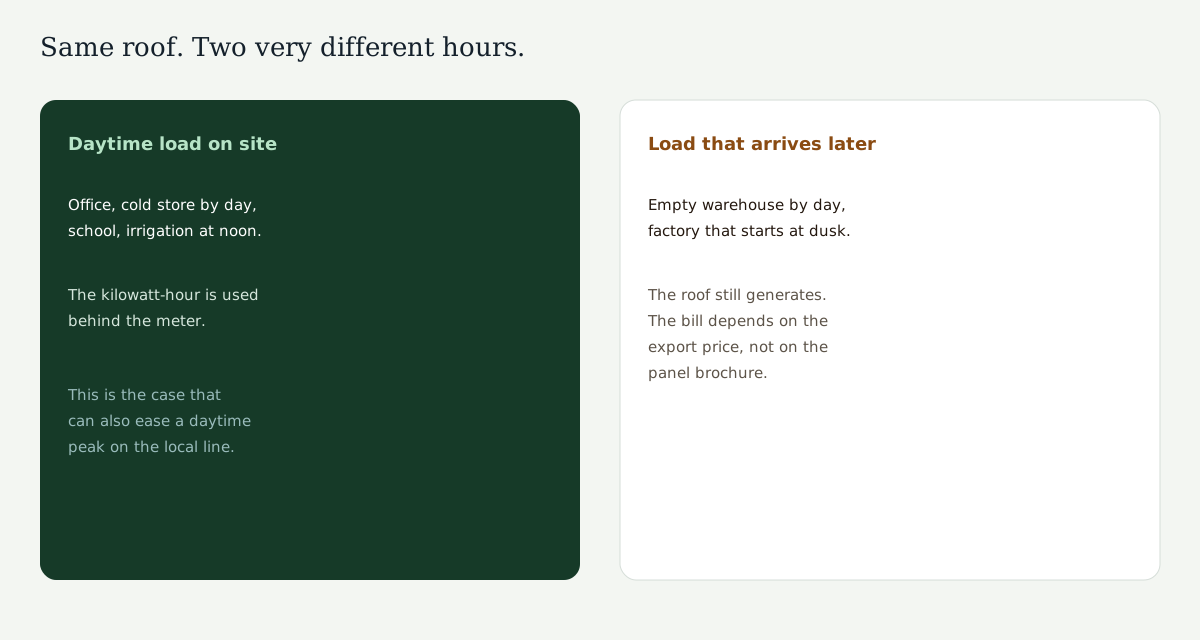
Self-consumption is the reason distributed PV kept growing in markets such as Germany, Brazil, France, Japan and Australia, in the IEA PVPS account. The mechanism is simple. Daytime load on the same meter — a school, an office, a cold store that runs while staff are in, irrigation that can run at noon — uses the electricity before it ever becomes an export. The bill saving is retail-shaped.
A building that is empty until evening has the same roof and a worse match. Generation still happens. The value of the surplus is whatever the export rule pays, which in some tariffs is well below the retail rate and in others is curtailed when the local transformer is full. Adding a battery is a second project: it moves energy into the later hour, at a round-trip loss, and it only pays when that gap is wide enough. It does not fix a roof that was simply larger than the daytime load.
The same hour-matching test is why a distributed plant can sometimes ease a local line and sometimes cannot. Relief shows up when the line’s stress is in daylight and the plant is generating then. A night-time peak is a different problem. The PV does not see it unless storage is there and is allowed to discharge.
One country’s 2014 map, read as history
On 2 September 2014 China’s National Energy Administration issued notice 406 on distributed PV. It pushed large roofs and places with a real daytime load: industrial parks, stations, airports, stadiums, car parks. It also allowed projects on abandoned land, barren hills, agricultural greenhouses, tidal flats, fish ponds and lakes, provided the electricity was used nearby. A narrower clause covered plants built on open ground or on a greenhouse that itself had no electricity demand. Those could still be counted as distributed if they connected at 35 kV or below (66 kV or below in the northeast), stayed within 20,000 kW for a single project, and were consumed mainly in the transformer area at the point of connection. That is an administrative frame from 2014. Later rules have moved, and other countries never used those thresholds.
A year earlier, the national interim measures for distributed generation had already listed where the idea applied, including remote pastoral areas and islands, and had told grid companies to use a simplified process for connections at 35 kV and below. Off-grid and island supplies sit in that earlier document. They are a different physical problem from a roof with a meter, because there is no grid to absorb the surplus.
A fish pond or a greenhouse only stays in that “used nearby” category when the original work continues. A pond that can no longer be farmed because the surface is sealed is a power station on water. A working pond with panels on piles is a different project. That distinction is the subject of solar on a working fish pond.
Off-grid is the case with no meter to hide behind
IEA PVPS keeps off-grid as its own idea even while the statistics mix it into distributed totals: solar pumping programmes, solar home systems, microgrids. Missouri Extension’s solar options sheet draws the same line in equipment. A PV-direct system has no battery and runs only while the sun shines, which suits a pump or a fan. An off-grid system stores energy because the load continues after dark, and it is often paired with a generator because the array and the battery will have a bad week. A grid-tied system without storage shuts down in an outage so it cannot energise the line.
If the “distributed plant” in a proposal is actually a village that goes dark at sunset, the design is the off-grid one. Classifying it by where the power is coupled is covered in independent PV, sorted by the load. Calling it a rooftop commercial system because the panels sit on a roof will undersize the battery and forget the generator.
What to demand from a scenario slide
A useful scenario names the load’s clock, the connection voltage, who may inject power, and what happens to surplus. A slide that only names a building type — factory, school, carport, farm — has not done that. Two factories with the same roof can be opposite projects if one runs a day shift and the other a night shift.
Reports, not brochures
IEA PVPS definition, BAPV against BIPV, and the 2025 capacity split: Trends in PV Applications 2026 (PDF: full report). Notice 406, 2 September 2014: National Energy Administration. The 2013 interim measures, including remote areas and the 35 kV process: State Council gazette. PV-direct, grid-tied and off-grid as equipment choices: University of Missouri Extension, solar system options (PDF).
