
A solar one-line diagram is a single-path map of the electrical equipment: modules to inverter, inverter to disconnects, disconnects to the service. It is the drawing you should be able to hold next to the wall. If a box on the paper has no match on the wall, or the wall has a battery the paper never drew, you do not yet know which system you are buying.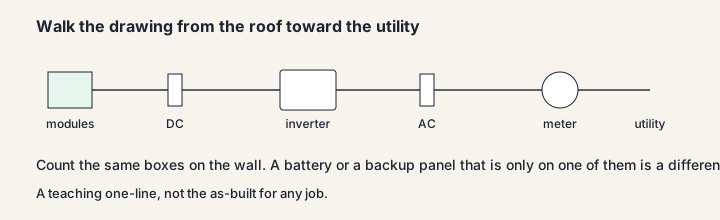
| On the drawing | What you should be able to find |
|---|---|
| Module strings into an inverter input | The same number of inputs, and a note of which roof face lands where |
| A DC disconnect and an AC disconnect | Handles you can point at. What they are for is in AC and DC disconnects. |
| The service or the backup panel | The panel the drawing names, not a different one down the hall |
| A battery, a CT, or an export limit, if the job includes them | Those devices, installed the way the notes say |
Sales drawing and as-built are different sheets
The first drawing is often the array someone hoped to sell. The as-built, if the job produces one, is the array that was landed. String counts change when a vent gets in the way. A battery gets deleted to make a price. Ask which revision you are looking at, and ask for the date. A drawing with no date is hard to argue with later.
Commissioning is when that drawing should be filed with the serials and the measured voltages. What else belongs in that folder is in what to record when solar is commissioned. A portal login is not a substitute for the sheet. Logins expire. The drawing is what the next electrician starts from.
What the lines do not prove
A line between two boxes does not prove the cable is the right type, or that the breaker matches the manual. Those decisions sit in notes, in a schedule, or nowhere. If they are nowhere, ask before you sign. East and west faces drawn as one string are a drawing error even if the picture looks tidy. That wiring mistake is in east and west solar roofs.
An export limit drawn as a number in the corner still needs the sensor the inverter will believe. The limit itself is in what an export limit does. A clamp drawn on the wrong side of the loads will not do what the number promises.
Whether a hybrid is the right box on that drawing is a separate decision, already covered in whether a hybrid inverter is worth it. This page only asks you to read the map you were handed and to refuse a map that does not match the equipment list.
A walk-through you can do without opening a panel
Start at the modules on the drawing and walk toward the utility. Count the strings. Count the inverter inputs. Count the disconnects. Then stand at the wall and count the same things. A missing DC handle, an extra battery, or a backup panel the paper never named is a conversation before you sign, or a conversation before you accept a completed job. Take a photograph of the drawing next to the labeled equipment. The next person will thank you.
Notes in the margin matter as much as the boxes. A grid code, an export limit, a CT direction, and a battery protocol are settings, not furniture. If they are not on the sheet, ask where they live. Commissioning photos of those screens are the backup if the drawing stays silent.
What to refuse
Refuse a drawing that shows a mixed east-west series string. Refuse a drawing that omits isolation you will still be asked to operate. Refuse a drawing dated before a change order that deleted the battery. A pretty one-line of a system you did not buy is how warranty desks and the next electrician start from the wrong house.
