
An export limit caps the power that leaves the building and goes onto the utility. Power the building is using at that same moment can keep coming from the inverter. The limit is a ceiling on export, enforced by reducing inverter output or, in some designs, by sending surplus into a load the installer assigned. It does not store energy, and it does not keep the lights on when the grid fails.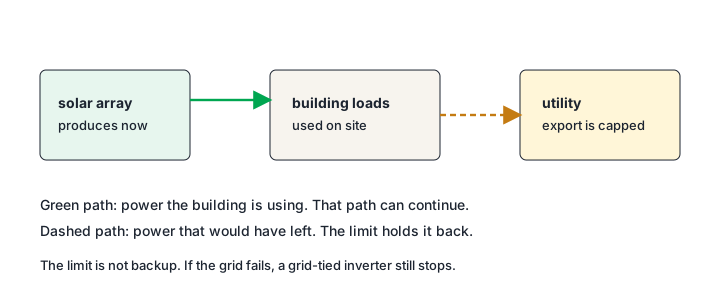
What keeps running when the cap is reached
Self-consumption is the solar used inside the building as it is produced. That flow never becomes an export, so a tight export cap does not forbid it. The bill effect of using solar on site, as against selling it, is explained in what self-consumption changes. How a tariff banks or prices whatever does leave is a separate contract, in what net metering means. A zero-export setting and a net-metering agreement answer different questions. One can exist without the other.
Take a teaching set of figures, labeled as hypothetical and not a quote, not a utility rule, and not a recommended size. Suppose the array can produce 5 kW, the building is using 2 kW, and the export limit is 0 kW. The inverter has to bring its output down toward 2 kW so that nothing extra leaves. The 2 kW the building is using can still be solar. If a kettle switches on and the load becomes 3 kW, the inverter may rise toward 3 kW, still exporting nothing. If a cloud drops the array to 1 kW while the load stays at 3 kW, the other 2 kW comes from the grid. Your meter, your limit, and your loads replace every one of those numbers.
A limit set above zero works the same way with a smaller cut. The inverter may export up to the cap and has to curtail only the surplus beyond it. People describe this as the system wasting power. The curtailment is real: those watt-hours are not generated. Whether that is acceptable is the reason the limit exists, usually a utility rule, a transformer constraint, or a tariff that pays very little for export. The hardware is obeying a ceiling. It has not failed because noon output sits under the array's nameplate.
The sensor has to see the right current
The inverter cannot limit export unless it can measure export. That measurement is usually a current transformer on the service conductors, or a meter that reports to the inverter. The sensor has to be on the conductor the manual names, in the direction the manual names, and on the side of the loads the manual names. A clamp on the wrong leg, a reversed clamp, or a clamp downstream of a subpanel that was added later will report a fiction. The inverter will then curtail the house load, or it will export while believing it is not.
A qualified person confirms the sensor against a known load: turn a substantial load on and off and watch whether the inverter's idea of import and export moves the right way. That test is in the commissioning list. Skipping it because the energy graph looks plausible is how a limit sits mis-wired for a year. If the utility required a particular limit as a condition of interconnection, the value in the menu has to match the agreement, and the installer has to be able to show how it was verified. A password-protected setting that nobody recorded will be a mystery at the next service call.
A cap on export is not a backup design
When the grid voltage disappears, a grid-following inverter stops, export limit or none. The house goes dark with the neighborhood unless a separate backup design opens the utility path and forms its own supply. That design is described in home battery backup for outages. A battery can also change the export arithmetic, by absorbing midday surplus that would otherwise hit the cap, and the battery manual has to allow the mode you intend. The export limit still only polices the service conductors. It does not decide which circuits are backed up.
If production falls short of a proposal that ignored the cap, read the limit first. A model that assumed every midday kilowatt-hour left the building at a retail rate will overstate the bill effect of a zero-export site. The fix is an honest production case, with the cap included, not a larger array that the same cap will curtail harder.
