
- What each disconnect isolates
- Where the disconnects have to be
- A shutdown that matches the equipment
- Frequently asked questions
- What is the difference between an AC disconnect and a DC disconnect?
- Is the breaker in my main panel the solar disconnect?
- Can I use the DC disconnect every night?
- Sources and references
An AC disconnect opens the alternating-current side of a solar inverter, the side that faces the building and the utility. A DC disconnect opens the direct-current side, the side that faces the photovoltaic array. They are not two names for one handle. Pacific Northwest National Laboratory’s operations guidance describes emergency shutdown as the AC disconnect first and then the DC disconnect. The order is the practice on that page. It is not a suggestion to invent a third switch, and it is not permission for an untrained person to operate equipment they do not know.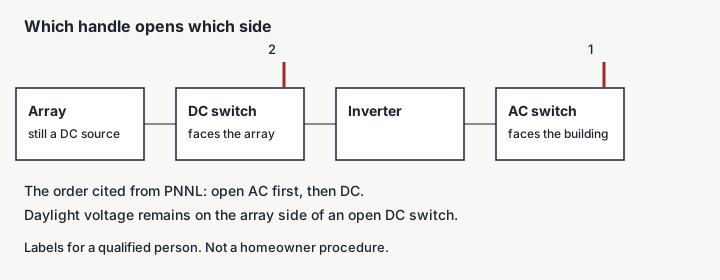
What each disconnect isolates
The AC disconnect separates the inverter from the service. It stops the inverter’s contribution to the building and the grid, which is also what anti-islanding is doing automatically when the utility itself disappears. A manual AC disconnect is how a person makes that separation on purpose, within sight of the inverter in the practices PNNL describes. Anti-islanding remains the inverter’s own duty to stop within 2 seconds under IEEE 1547-2018. The handle does not replace that function, and that function does not replace a handle a worker can see and lock. Anti-islanding is in what anti-islanding is.
The DC disconnect separates the inverter from the array. Until it is open, the inverter’s DC terminals are connected to a source that produces in daylight. Opening the AC side first means the inverter is not pushing current into the building while you then open the DC side. Opening the DC side under the inverter’s full input, as a first and casual move, is not the order PNNL prints. After both are open, the array is still capable of voltage on the array side of the DC disconnect. “The disconnect is off” does not make the modules safe to unplug. Connectors are not the disconnect. They are in solar connector basics.
A combiner with string fuses is not automatically either disconnect. A fuse clears a fault. An isolator is a switch rated to open the circuit. A rapid-shutdown function, where the local code requires one, is listed equipment that addresses conductor voltage for responders. It does not delete the AC and DC disconnects from the drawing. Rapid shutdown is in what rapid shutdown is. The combiner is in what a solar combiner box is.
Where the disconnects have to be
PNNL notes that disconnects are expected within sight of the inverter, so the person at the inverter can see that the means of isolation is open. A disconnect in another room, behind a locked gate, or buried in a closet the family filled with storage, fails that purpose even if the electrical ratings are perfect. Walk the path before the system is built. Access is part of whether the roof should have an array at all. That earlier list is in what to check before a rooftop solar installation.
Label the handles. An unlabeled breaker in a crowded panel is not an AC disconnect in any practical sense. The placard should say what it shuts down. On a backup system, the transfer equipment is a third function: it opens the utility so the backup inverter can form an island for selected circuits. That transfer is not the DC disconnect, and defeating it to “keep the solar on” can energize the street. Backup scope is in home battery backup for outages.
Night does not change the hardware. The array is not producing, so the hazard is lower, and the disconnects are still the way a qualified person isolates the inverter for a repair. A habit of flipping them every evening is not maintenance and not a saving. Why the inverter should stay on overnight is in should you turn a solar inverter off at night.
A shutdown that matches the equipment
| Step people confuse | What it actually does |
|---|---|
| Open the AC disconnect | Separates the inverter from the building and the utility. First in the PNNL emergency order. |
| Open the DC disconnect | Separates the inverter from the array. Second. The array side can still be live in the sun. |
| Pull a module connector | Not a shutdown step for an owner. Not under load. Not a substitute for the disconnect. |
| Rely on anti-islanding alone | Correct for an unplanned utility outage. Not a lockable, visible isolation for someone working on the inverter. |
Restoring power is the reverse of a casual idea, and it belongs in the inverter manual. A qualified person closes the DC disconnect, then the AC disconnect, and lets the inverter start when the array and the grid are valid. Forcing a start with a modified sequence from a different brand is how fault codes get cleared before anyone has read them. Maintenance that stays outside the cover is in how to maintain a solar inverter. If you do not know which handle is which, stop. The ratings are high enough that curiosity is not a training program.
Frequently asked questions
What is the difference between an AC disconnect and a DC disconnect?
The AC disconnect opens the inverter’s connection to the building and the utility. The DC disconnect opens the inverter’s connection to the solar array. Emergency shutdown in PNNL’s description is AC first, then DC. They are different handles because the two sides are different circuits.
Is the breaker in my main panel the solar disconnect?
It might be the AC disconnect if it is the breaker the design labeled for that job and it is within sight of the inverter, as the practice PNNL describes expects. A random breaker is not. The DC disconnect is still a separate device on the array side.
Can I use the DC disconnect every night?
You can isolate the system when a qualified person needs it isolated. A nightly routine does not save meaningful energy and can leave the inverter off through the next sunny day. Leave the disconnects alone unless you are shutting down for a reason the manual or a technician gave you.
Sources and references
AC disconnect then DC disconnect, and disconnects within sight of the inverter, in the operations practices described: Pacific Northwest National Laboratory. Cease-to-energize within 2 seconds: IEEE 1547-2018 primer. No local code article is quoted. Where the authority having jurisdiction requires a rapid-shutdown listing, that listing is additional to these disconnects.
