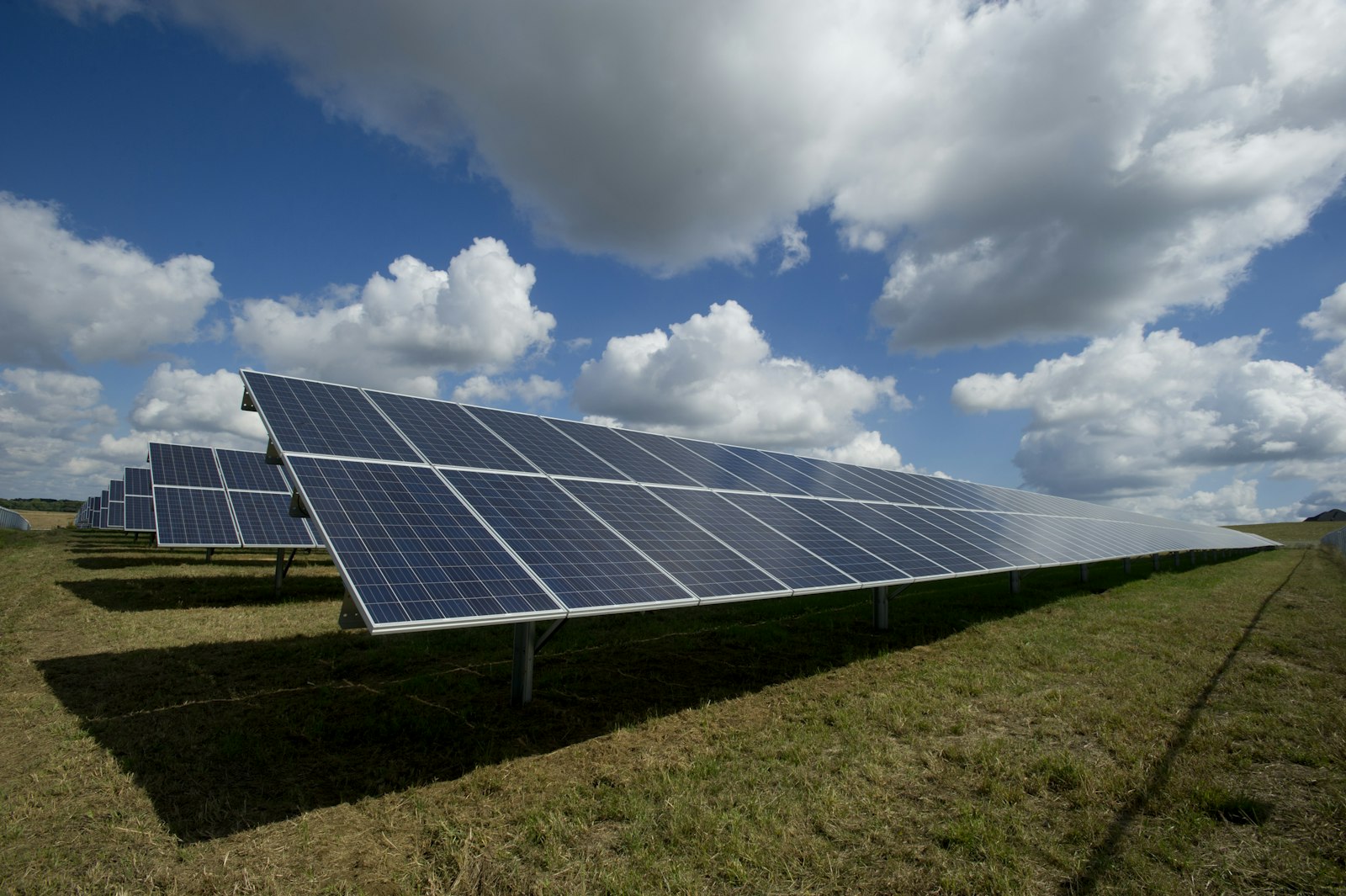
- Commercial and residential solar, side by side
- Datasheet lines to read on both quotes
- Which project the module is actually joining
- Frequently asked questions
- Are commercial solar panels more efficient than residential ones?
- Can a house use a module sold as commercial?
- Does every commercial building need three-phase solar?
- Sources and references
Commercial and residential solar are different projects that often use the same kind of module. A laminated sheet of cells, glass, and a frame can sit on a house or a warehouse. What changes is the roof, the utility service, the hours the building actually uses power, and who can get back up there in five years. A higher wattage on the nameplate does not create a separate species of panel called “commercial.”
Commercial and residential solar, side by side
| What you are comparing | House | Business |
|---|---|---|
| The module | Same laboratory point: standard test conditions, a flash file, coefficients, maximum system voltage. The sector label is not on that sheet. | |
| Utility service | On Southwestern Electric Power’s 2024 system, residential service is single-phase 120/240 V, or 120/208 V where a network exists. That is one utility, not every country. | On that same system, commercial secondary service may be single-phase or three-phase. Ask. A shop is not automatically three-phase, and a house is not automatically single-phase on every utility. |
| Where the power lands | Pacific Northwest National Laboratory notes that a small array, under about 50 kW in that description, may land on the building service, while a larger one may need a transformer. The 50 kW line is their illustration, not a legal boundary between a home and a business. | |
| When the load runs | Often evening, after the array has faded. Midday export depends on the tariff. See what net metering means. | A day-shift factory can overlap the sun. A cold store that runs at night does not, even if the modules were sold as commercial. Load shapes are in commercial solar panel applications. |
| Getting back to the glass | A house roof can be steep and awkward. Access drives later cost. | A high, low-tilt warehouse roof can be easier to walk and harder to keep clean. PNNL ties maintenance cost to that access. |
Datasheet lines to read on both quotes
If two quotes offer different modules, compare these lines on the sheets. They are properties of the product in front of you. A house and a warehouse can carry the same values, or different ones, without either sheet becoming a “residential module” or a “commercial module.”
| Line | What you are checking |
|---|---|
| Rated power and efficiency at standard test conditions | The nameplate at one laboratory point. Xcel Energy’s 2023 buying rules, for crystalline modules that utility acquires, ask for this, plus a positive-only power tolerance. |
| Dimensions | How the glass fits the roof and the rack. This page did not open a pair of house and factory datasheets, so no typical size is stated. |
| Open-circuit voltage (Voc) and voltage at maximum power (Vmp) | String voltage. Voc rises when the cells are colder than the test. Current-voltage values are among the fields that same Xcel specification asks for. |
| Short-circuit current (Isc) and current at maximum power (Imp) | Conductor and inverter current. Again, read the sheet in the quote. |
| Maximum system voltage | The insulation limit the module was listed for. The inverter input has its own limit. Both have to clear the cold string. |
| Temperature coefficients | How power and voltage move off 25°C. Xcel asks for them. There is no single percent for every module. |
| Mechanical load ratings | The snow and wind load the module was tested to. Your local design load is a separate number. A buyer’s sentence about resisting snow, wind, hail, and dust still does not state a hail diameter. |
Standard test conditions, as used in the efficiency tables version 68, are a global AM1.5 spectrum, 1,000 watts per square meter, and a cell temperature of 25°C. Two modules can carry different nameplate watts at that same test point and still be the same kind of product. The larger number may be a larger module, a later cell design, or both. The watts belong on the sheets in the quote, not in a sector average. Heat moves the afternoon watts by the coefficient on that sheet, which is covered in how heat affects a solar module. Cell family is a separate choice: monocrystalline modules and thin-film modules both appear on houses and on businesses.
Mechanical ratings matter more than the sector sticker when the roof is the constraint. A buyer’s specification can say framing should resist snow, wind, hail, and blowing dust and still not state a hail diameter. Use the load numbers on the sheet you are buying, and the local snow and wind loads, not a slogan. How to walk a label is in how to read a solar panel datasheet.
Which project the module is actually joining
Buy the module for the flash file, the coefficients, the maximum system voltage, and the warranty PDF. Buy the inverter for the service letter. A small commercial roof can use the same module family as a house and still need a three-phase inverter because that is what the utility wrote down. A large house can stay single-phase for the same reason. Phase is explained in single-phase versus three-phase solar inverters.
Array size does not flip the category either. A house can have a large roof and a factory a small one. What changes with size is how many strings share a tracker, whether a transformer shows up, and how the interconnection is reviewed. The module does not change species at a kilowatt threshold.
Warranties stay contracts. A program specification can require 10 years of product coverage and 80 percent of nameplate for 25 years. Your PDF can be shorter. The word “commercial” on the box does not fill in a missing clause. How to read the years is in what a solar panel warranty covers. Measured aging, which is not the same document, is in how long solar panels last.
Both arrays are live in daylight. Shutdown is still the AC disconnect, then the DC disconnect, by someone trained. Shade is still nonlinear. Dirt is still easy to miss. A large roof is not exempt, and a small one is not fragile by definition. Those are site facts from Pacific Northwest National Laboratory’s operations notes, not a difference in the glass chemistry.
Frequently asked questions
Are commercial solar panels more efficient than residential ones?
Not as a category. Compare the flash tests of the two modules in the quotes, at standard test conditions. A higher nameplate can be a larger piece of glass. The sector name does not add a percentage.
Can a house use a module sold as commercial?
Yes, when the maximum system voltage, the inverter window, the roof structure, and the utility interconnection all accept that module. The brochure heading is not the constraint.
Does every commercial building need three-phase solar?
No. On the one US utility cited here, commercial service may be single-phase or three-phase. Other utilities and other countries differ. Match the letter, not the building type.
Sources and references
Service voltages on one US utility: SWEPCO electric service handbook, 2024. Array landing near the service, access, and live modules: Pacific Northwest National Laboratory. Datasheet fields a buyer can require: Xcel Energy, November 2023. Standard test conditions: Green and colleagues, efficiency tables version 68.
