
- The same month, two ways of settling it
- What the tariff line actually decides
- What this rule does not do
- Frequently asked questions
- Does net metering pay the retail rate for every solar kilowatt-hour?
- Is the old list of US state programs still the map?
- Can I use a net-metering credit during a blackout?
- Sources and references
Net metering is a billing rule some tariffs use. Excess solar that the building does not use at that moment can leave through the meter and come back as a kilowatt-hour credit against electricity you buy later. The National Laboratory of the Rockies describes that kind of credit as usable in the current billing cycle or a later one, and describes both self-consumed and exported kilowatt-hours as worth at least the retail rate under that arrangement. That description is not a promise that every customer, or every utility, banks exports one-for-one at retail. Banking, the export price, and what happens to leftover credits at the end of the year are lines on your tariff.
The same month, two ways of settling it
These figures are an illustration of the arithmetic. They are not a utility’s rates, not a typical home, and not a 2026 policy.
In the example month the array produces 600 kWh. The building uses 400 kWh of that while the sun is up, so 200 kWh is exported. In the evening the building buys 250 kWh from the utility.
Under the net-metering shape above, the 200 kWh exported can offset 200 of the 250 kWh bought later. The billable grid energy in the example is 50 kWh, priced at whatever retail rate the schedule uses. The 400 kWh used on site never appears as a purchase.
Under net billing, as NLR describes it, the 400 kWh used on site is still valued at retail, because you did not buy it. The 200 kWh exported is paid at a sell rate, often closer to avoided cost, and kilowatt-hours are typically not banked across the month. The evening 250 kWh is still purchased at retail. You do not subtract 200 kWh from 250 kWh. If the sell rate in this illustration were 8 cents and the retail rate 20 cents, the export would be a $16 credit and the evening purchase would be $50, before any fixed charges. Change either rate and the bill changes. Neither rate is claimed as anyone’s actual price.
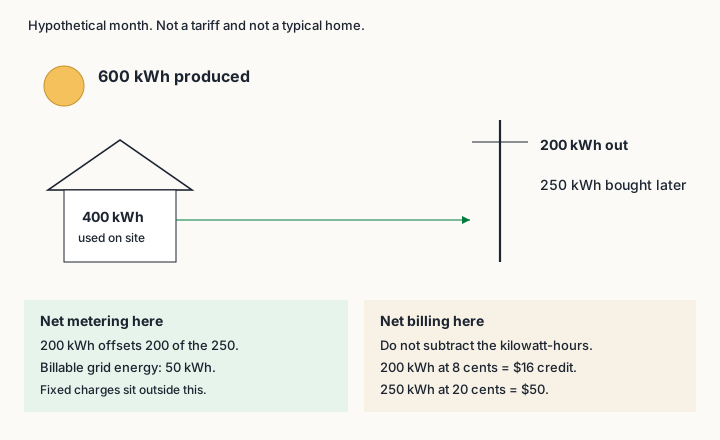
Fixed monthly charges sit outside both versions of the example. A customer charge, a minimum bill, or a demand charge on a commercial meter can remain after the energy rows look small. The 600, 400, 200, and 250 kilowatt-hour figures price energy only.
On a real bill, look for three quantities rather than one “solar” line: energy produced, energy exported, and energy bought back. If the export line is in kilowatt-hours that reduce a later purchase, you are looking at the net-metering shape. If the export line is a dollar credit at a posted sell rate, you are looking at net billing, whatever the salesperson called it.
A value-of-solar tariff, in a 2015 NREL survey of compensation options, pays exports at a calculated rate meant to reflect costs and benefits someone chose to count. The survey says that calculation is contentious. It is a third arrangement, separate from both rows above, and this page will not invent the rate.
What the tariff line actually decides
| What the schedule says | How the example month behaves |
|---|---|
| Credit in kilowatt-hours, usable later | The net-metering shape. Exported kWh can offset later kWh. A 2015 NREL survey says leftover credits at the end of the period, often a year, may be paid at a wholesale-style rate, rolled forward, or forfeited. Yours will say which. |
| Export paid at a sell rate, no banking | Closer to net billing. Self-consumed solar can still be worth the retail rate. The meter is not running backward one-for-one. |
| A calculated export price | A value-of-solar idea. Contentious by the survey’s own account. Read the formula in the tariff, not a summary. |
Export only happens when production exceeds the load at that moment. A day-shift factory may export little. A house empty at noon may export a lot and buy the evening back, if the credit rules allow it. Load shapes are in commercial solar panel applications. Whether a battery is worth adding depends on this table: a one-for-one kilowatt-hour credit can already cover the evening, while a low sell rate can make storage useful. The battery decision is in adding a battery to existing solar. Payback arithmetic that prices every kilowatt-hour at retail is assuming the first row: how a solar payback period is calculated.
What this rule does not do
The credit does not keep the lights on when the utility is down. It is a bill entry while the grid is operating. On a US interconnection, the inverter’s duty to stop feeding a separated line is IEEE 1547 territory, explained in solar inverter protection functions and what anti-islanding is. Backup is a different design: grid-tied versus off-grid solar.
It is also not a map of which utilities offer it in 2026. The Energy Policy Act of 2005, as a SEPA primer from that era describes it, required state regulators in the United States to consider net metering. Consideration was not a permanent retail-rate mandate, and the primer’s state list is a historical snapshot. It does not apply to other countries. Read the schedule on your meter, including any size cap, any closure to new customers, and what happens to leftover credits at the end of the annual period.
Frequently asked questions
Does net metering pay the retail rate for every solar kilowatt-hour?
Under the NLR description of net energy metering, exported kilowatt-hours offset later use at least at the retail rate, when banking is allowed. Net billing usually pays exports at a sell rate instead. Match the line on your schedule to the table above.
Is the old list of US state programs still the map?
No. Treat the SEPA primer and the 2015 NREL survey as explanations of mechanisms and as history. Programs change, cap enrollment, and differ by utility. The current schedule is the only current map.
Can I use a net-metering credit during a blackout?
No. The credit reduces a later bill. It is not energy stored in the meter for an outage. Outage power needs equipment that can disconnect from the utility and supply selected circuits.
Sources and references
Net energy metering as a kilowatt-hour credit, and the contrast with net billing: National Laboratory of the Rockies, energy compensation mechanisms. Credits inside a cycle, carryover, and year-end treatment: NREL, compensation for distributed solar, 2015. Historical US context, not a 2026 map: SEPA net energy metering primer. The 8-cent and 20-cent rates, and the 600, 400, 200, and 250 kWh figures, are hypothetical and are not taken from those documents.
