- How Are Cadmium Telluride Solar Cells Built?
- What Efficiency Do Cadmium Telluride Solar Cells Reach?
- Is the Cadmium in Cadmium Telluride Solar Cells a Hazard?
- Where Are Cadmium Telluride Solar Cells Used?
- Frequently asked questions
- Is a cadmium telluride module 23.1% efficient?
- Is the cadmium a loose hazard in normal use?
- Does “six times less carbon dioxide” settle a comparison with silicon?
- Sources and references
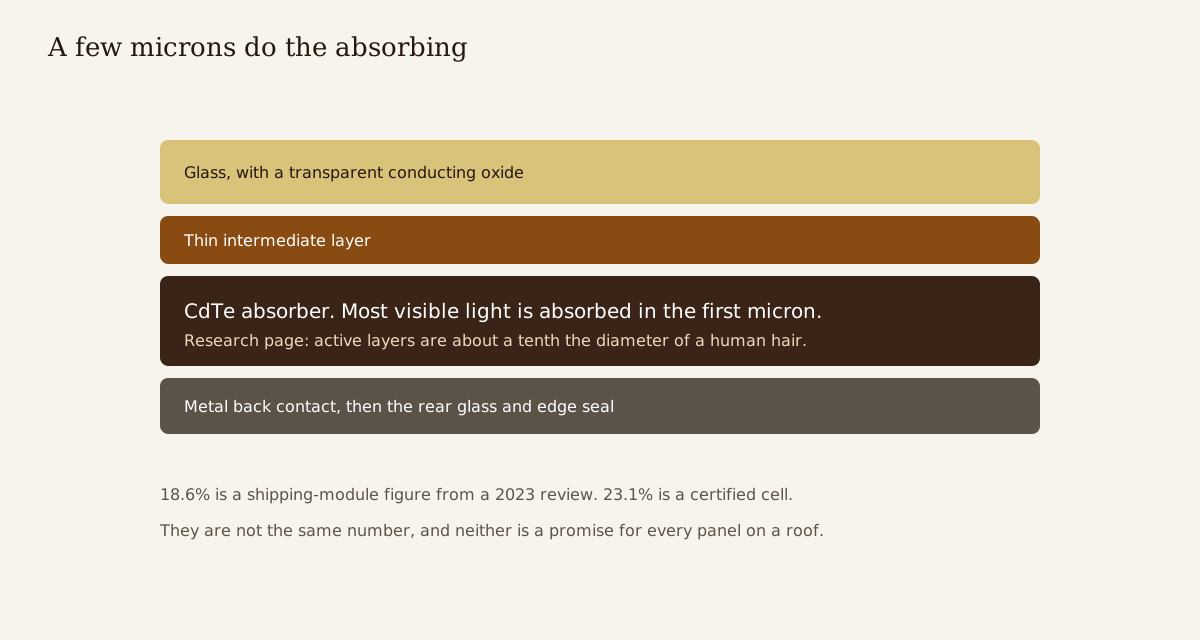
Cadmium telluride solar cells are thin-film devices. A layer of cadmium telluride a few microns thick absorbs the light. The National Laboratory of the Rockies’ photovoltaic research page describes those active layers as about a tenth the diameter of a human hair, and says most visible light is absorbed in the first micron of the cadmium telluride. That is a different object from a crystalline silicon wafer, which is sliced and contacted as a much thicker piece of semiconductor.
Updated October 2026. Module efficiencies and cell records below are from named sources. They are not interchangeable, and they are not a rating for an unnamed panel.
How Are Cadmium Telluride Solar Cells Built?
That laboratory page’s description of a typical cell starts on glass. A transparent conducting oxide, such as tin oxide or cadmium stannate, lets visible light through and carries current. An intermediate layer, such as cadmium sulfide, sits between that oxide and the absorber and affects both growth and the electrical junction. The cadmium telluride film is the photoconversion layer. Together those layers form the electric field that turns absorbed light into current and voltage. Metal on the back is the contact. In production, the layers are deposited on incoming glass and finished into a panel in a few hours. The Department of Energy’s cadmium telluride page puts that manufacturing time at under 4.5 hours. Treat the 4.5 hours as that page’s process claim for this technology, not as a stopwatch for every factory.
The same DOE page says modern cells often add cadmium selenium telluride alongside cadmium telluride to absorb more of the spectrum. Cadmium and tellurium, it says, are byproducts of zinc and copper mining, refined after those mines rather than mined for the solar cell alone. A 2023 review in Solar Energy Materials and Solar Cells describes the commercial path as window-layer optimization plus an alloyed cadmium selenium telluride absorber, with chlorine and selenium playing a part in raising minority-carrier lifetime.
What Efficiency Do Cadmium Telluride Solar Cells Reach?
The 2023 review says more than 30 GWp of cadmium telluride modules were installed worldwide, that more than one company was in production, that modules were shipping at up to 18.6% efficiency, and that laboratory cells were above 22%. An NREL technical report on the CdTe Core project says the work contributed to a run of certified records ending in a 23.1% cell. The report also says NREL improved average photovoltage on its own arsenic-doped baseline devices by over 100 mV, and it describes domestic production, in collaboration with First Solar, expanding to about 10 GW.
Use those numbers in the boxes they came from. 18.6% is the review’s upper figure for modules then shipping. 23.1% is a certified cell in that NREL report, not a module nameplate. 30 GWp is installed capacity in the review, not a market-share percentage, and this article did not re-audit the underlying plant list. A buyer comparing a cadmium telluride module with a silicon module should use the two datasheets, at the same test conditions, including temperature coefficient and the warranted power, rather than either headline.
Is the Cadmium in Cadmium Telluride Solar Cells a Hazard?
The absorber is a cadmium compound. Encapsulated in glass, in service, it is not a loose powder. That is not the same sentence as “there is no cadmium” or “there is no end-of-life obligation.” The US Environmental Protection Agency notes that some panels contain enough metals, including cadmium in some technologies, for an end-of-life waste determination, and that some panels do not meet the hazardous-waste threshold. Which outcome applies is a test of that module, not a property of the word thin-film.
The DOE page says more than 90% of a cadmium telluride module can be recycled, and that producing one generates six times less carbon dioxide than producing a silicon module. Both sentences are on that page. This article did not review the life-cycle study behind the six-times claim, so it should not be repeated as an independent result. Ask the manufacturer for the recycling route they actually operate, and for the study, if the comparison is going into a procurement document. Collection and recycling rules more generally are in how to recycle a solar panel.
Where Are Cadmium Telluride Solar Cells Used?
The same research page calls cadmium telluride the largest segment of commercial thin-film module production, and describes it as having matched multicrystalline silicon efficiency while keeping a cost position. The physical form is a glass-glass laminate made in one deposition sequence, which suits large, uniform arrays more naturally than a small residential roof with many penetrations and partial shade. Shade, orientation, and module-level electronics are a silicon-module problem with a different set of tools. The manufacturing contrast with a wafer line is in how silicon panels are made.
Nothing in the cell record removes the need for the module certificate, the mechanical load, the warranty, and the local electrical rules. Thin film is a device structure. It is not a permit.
Frequently asked questions
Is a cadmium telluride module 23.1% efficient?
The 23.1% figure in the NREL CdTe Core report is a certified cell. The 2023 review’s figure for modules then shipping is up to 18.6%. A purchase uses the nameplate of the model being bought.
Is the cadmium a loose hazard in normal use?
It is the absorber, sealed in the module. End of life is a separate question. Some panels meet a hazardous-waste threshold because of metals such as lead or cadmium, and some do not. The EPA treats that as a waste determination, not as a label that covers every thin-film product.
Does “six times less carbon dioxide” settle a comparison with silicon?
That comparison is stated on the Department of Energy’s cadmium telluride page. It is not a calculation repeated in this article. Use it only with the underlying study, the boundary of the comparison, and the modules actually being compared.
Sources and references
Device structure and the scale of the film: National Laboratory of the Rockies, cadmium telluride solar cells. Manufacturing time, byproduct metals, the 90% recycling line, and the carbon-dioxide comparison: Department of Energy, cadmium telluride. Installed capacity, 18.6% modules, and laboratory cells above 22%: Scarpulla and colleagues, Solar Energy Materials and Solar Cells, 2023. The 23.1% certified cell and the project’s voltage work: NREL, CdTe Core final technical report, OSTI.
