- What Is a Solar Panel Made of Before Recycling?
- How Does Solar Panel Recycling Recover Materials?
- Which Solar Panel Recycling Rules Apply?
- Should You Reuse a Solar Panel Before Recycling It?
- Frequently asked questions
- Can a solar panel go in household recycling?
- Does the EU recycling duty apply to every panel in the world?
- Does recycling recover 85% of the panel?
- Sources and references
To recycle a solar panel, take the laminate apart and return what you can to a materials stream. For a crystalline silicon module, the glass is most of the weight, and the aluminium frame and the copper wiring already have recyclers. The silicon cell, the silver in the contacts, and the polymers that glue the sandwich together are the part the industry has not made ordinary. Putting a panel in a household recycling bin is not that process.
Updated October 2026. Rules differ by country. A 2016 description of European law is not a 2026 permit, and a US hazardous-waste discussion is not a European one.
What Is a Solar Panel Made of Before Recycling?
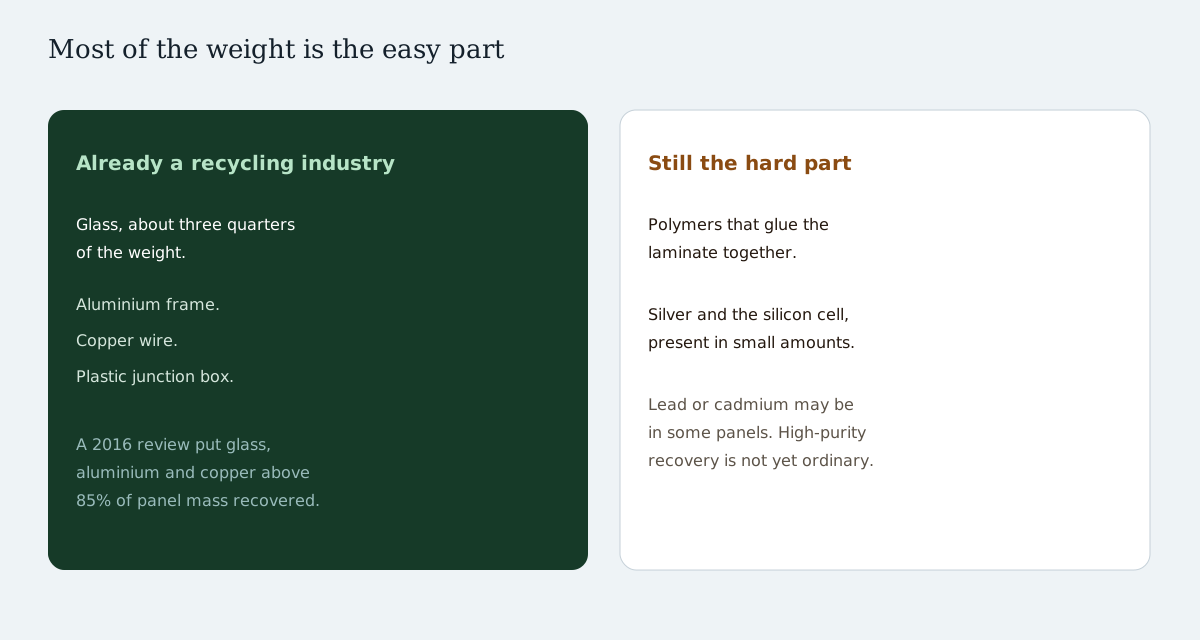
The US Environmental Protection Agency describes a typical crystalline silicon panel as an aluminium frame, glass, copper wire, polymer layers, a backsheet, silicon cells, and a plastic junction box. Glass is about 75% of the weight, and glass recycling already exists. The frame, the external copper, and the junction box come off first. The polymer layers are there to keep weather out, and the EPA notes that separating them often takes high temperature because the adhesive does not let go.
Silver and the copper inside the cell are valuable and present in small amounts. Lead and cadmium may be present, depending on the module. A cadmium telluride thin-film module is a different stack from this crystalline description. Its end of life is discussed with the device in cadmium telluride solar cells.
How Does Solar Panel Recycling Recover Materials?
The EPA lists an ideal sequence: remove the frame and the junction box; separate glass from the silicon wafer by heat, mechanics, or chemistry; then separate and purify the silicon and the specialty metals, including silver, tin, lead, and copper. It also describes what is actually common. Existing glass, metal, and electronics plants can crush and shred modules after the frame comes off. Glass, aluminium, and copper may be recovered. The silicon cells may be incinerated rather than returned as silicon.
A 2016 report from the International Renewable Energy Agency and IEA PVPS said that batch runs in general recycling plants could recover glass, aluminium, and copper at cumulative yields above 85% of panel mass. That sentence is about mass, in the plants they reviewed, in 2016. It is not a claim that 85% of the silver or of the silicon value comes back. A 2024 IEA PVPS report on recycling life-cycle data says the economics improve when silicon and silver are recovered at high purity, and that public data on commercial and pilot plants remain limited. Those two sentences should be read together. Mass recovery of the glass is the established step. High-purity recovery of the cell is the step that is still uneven, and it should not be quoted as if every recycler does it.
Which Solar Panel Recycling Rules Apply?
The 2016 IRENA and IEA PVPS report said the European Union was, at that time, the jurisdiction with photovoltaic-specific waste rules. Under the Waste Electrical and Electronic Equipment directive, producers who supply panels to the EU market finance collection and recycling of those panels, wherever the company is based. That is a producer duty on panels placed on the EU market. It does not automatically bind a panel sold in another country. National transpositions have dates and thresholds. Check the current text in the country of sale before you treat a 2016 summary as the invoice.
In the United States, the EPA says some end-of-life panels are not hazardous waste, and some contain enough metals, such as lead, to meet the hazardous-waste definition under the Resource Conservation and Recovery Act. The agency has said it is drafting a proposal to add hazardous-waste solar panels to the universal-waste rules in 40 CFR Part 273. Drafting a proposal is not the same as a rule in force. Until that rule exists, the panel’s status is a waste determination, not a slogan that “solar panels are recyclable, so the bin is fine.”
The EPA also quotes an IRENA estimate that by 2030 the cumulative value of recoverable materials from end-of-life panels would be about $450 million globally, roughly the raw materials for 60 million new panels. The underlying report is from 2016. Treat the dollar figure as that forecast, not as a measured 2026 market.
Should You Reuse a Solar Panel Before Recycling It?
A panel that still produces, and that is safe to reinstall, is not yet a recycling problem. The EPA describes reuse and refurbishment as a second life, and notes that the US secondary market had not gained traction. Grid interconnection, fire code, and electrical code still apply if the module is connected again. Off-grid uses avoid some of those rules and keep others: the module’s connectors, insulation, and remaining power still have to be fit for the new job.
For a plant being decommissioned, the practical order is: test what can be reused, then send the rest to a recycler that will say which fractions it actually recovers. The EPA points to accredited electronics-recycling programmes, such as SERI’s R2 and e-Stewards, as one way to choose. Ask the recycler, in writing, whether silicon and silver are recovered or whether the process stops at glass, aluminium, and copper. The answer changes the environmental claim you are allowed to make.
Frequently asked questions
Can a solar panel go in household recycling?
No. Household streams are not set up to separate a laminated module. The EPA’s description starts with removing the frame and the junction box, then dealing with glass, polymers, and the cell. Use a photovoltaic recycler or the producer scheme that applies where the panel was sold.
Does the EU recycling duty apply to every panel in the world?
The WEEE duty described in the 2016 IRENA and IEA PVPS report applies to panels supplied to the EU market. A panel sold elsewhere follows that country’s waste rules. In the United States, some panels can be hazardous waste under RCRA and some are not. Test and jurisdiction decide.
Does recycling recover 85% of the panel?
The 2016 report’s figure above 85% is cumulative mass for glass, aluminium, and copper in the batch processes it reviewed. It is not a measured recovery of silver or of high-purity silicon. The 2024 IEA PVPS report treats that higher-purity recovery as the open economic problem.
Sources and references
US Environmental Protection Agency, what is in a panel, the recycling steps, the IRENA value quote, reuse, and the universal-waste proposal: solar panel recycling and the universal-waste proposal. Mass recovery and the EU producer duty as of 2016: IRENA and IEA PVPS, End-of-Life Management. Limits of public data on silicon and silver recovery: IEA PVPS Task 12, 2024.
