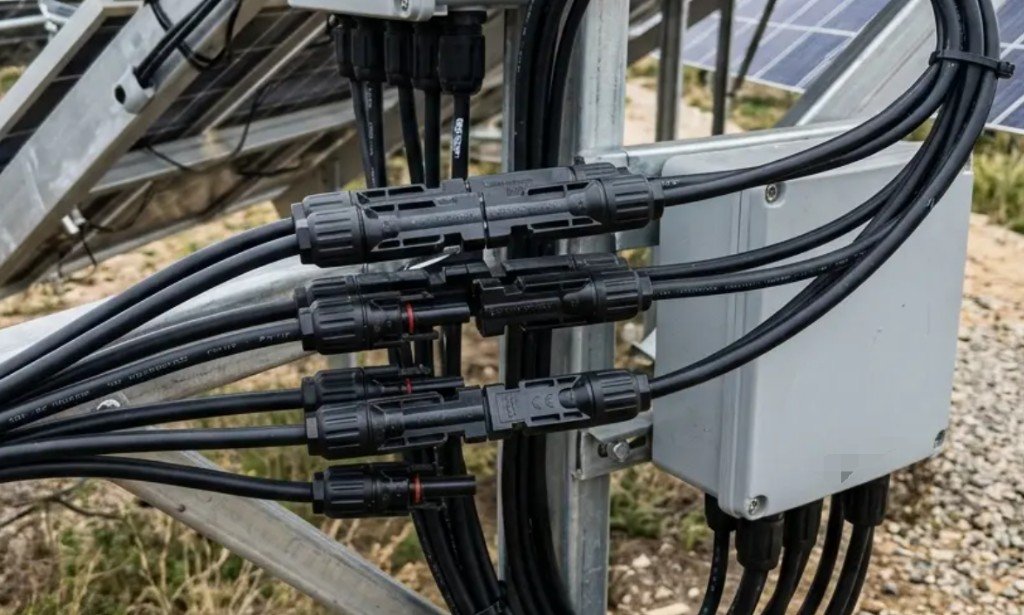
- 1. Choose the solar module connector voltage
- 2. Match connector current to the module string
- 3. Match the connector to the joint
- 4. Fit the solar module connector to the PV cable
- 5. Check the solar module connector certificate and the mate
- ShineTong solar module connectors
- Frequently asked questions
- What voltage should a solar module connector be rated for?
- How much current does a solar module connector need?
- What cable fits a solar module connector?
- Is IP67 or IP68 required on a solar module connector?
- Can two solar module connectors from different brands be used together?
- Sources
Five checks decide a solar module connector before the part number does: system voltage, string current, the job of that joint, the cable it must grip, and the certificate for that exact model. Work through them in that order. A connector that looks right and fails the second check is still the wrong connector.
IEC 62852 is the standard for these DC connectors. It allows products up to 1,500 V DC and 125 A per contact, and it sets a minimum degree of protection of IP55. Those are the edges of the standard. They are not the rating printed on every housing.
1. Choose the solar module connector voltage
Use 1,000 V DC or 1,500 V DC, whichever the string is designed for. The connector marking has to clear the highest voltage the string can reach, including a cold morning, when open-circuit voltage rises. That is the same maximum already used for the inverter input. A label that only matches the module at standard test conditions can be short of the January figure.
A 1,000 V connector and a 1,500 V connector are different parts, even when the plastic looks the same. MC4-Evo 2 is a 1,500 V name inside one product family. It does not upgrade every MC4-style body on the market to 1,500 V. Read the model. Moving a design from 1,000 V to 1,500 V cuts the number of strings, and it also throws out every connector, fuse, and isolator that was only listed at 1,000 V.
2. Match connector current to the module string
Current is not one number for “an MC4.” BEAMA notes that published ratings commonly run from about 30 A to more than 69 A, depending on the manufacturer and the conductor, and that a current one connector carries on 4 mm² may require 6 mm² on another. Ask for the rating at your cable size and at the upper ambient, not the largest cell on the first page.
Compare that figure with the circuit current in the design, including the module short-circuit current where the rules say to. A connector rated only a hair above the string, then left on a hot roof or in a tight bundle, is the one that runs warm. A branch that parallels two strings has to be rated for the sum, not for one module.
Do not reuse a module connector on a battery-to-inverter link because the plug looks familiar. BEAMA points out that storage circuits can run at currents the photovoltaic connector standard is not written for, and many of those links are lugged or use the inverter maker’s own connector.
3. Match the connector to the joint
Most module joints are a simple pair: module to module, or module lead to an extension. The half that touches the factory lead has to be the connector named on the module, the optimizer, or the microinverter. Start there. The catalogue does not get a vote until that line is read.
A Y or a T is a different part. It is for parallel strings, in the same product family as the inline pair, with polarity that matches the drawing. It is not a way to join two brands in the middle of a roof. If the joint is only cable you are cutting yourself, both halves can be one family you specify. If the joint touches a factory lead, that lead wins.
4. Fit the solar module connector to the PV cable
Choose the cable before the connector. Cross-section follows the current and the run length. On short module leads, 4 mm² is the usual photovoltaic cable. A long homerun may need 6 mm². The connector then has to accept that conductor and the jacket diameter of the reel you will pull.
Jacket diameter is not the copper size. Two cables of 4 mm², to IEC 62930 or the older EN 50618 type sold as H1Z2Z2-K, can differ on the outside. The seal and the gland only work inside the band in the assembly sheet. Forcing a larger jacket, or leaving a loose one, is how an IP number on the datasheet never happens on the roof. Ask for strip length and the die for that contact at the same time. The crimp is part of the current rating.
5. Check the solar module connector certificate and the mate
Two connectors with the same voltage can still fail the paperwork. For an IEC project, ask for IEC 62852 on a certificate that names the model and the factory. For a US project, ask for UL 6703. TÜV Rheinland tests photovoltaic connectors to those standards; the mark still has to be tied to the part you are buying, not to a sister product. A logo moulded into the nut is not the file.
Mating is the other half of the file. “MC4” is a market name, not an IEC designation, and parts that click are not automatically a certified pair. IEC 62852 tests a connector with its own counterpart. From the 2020 NEC, section 690.33(C) requires the same type and brand, or a pair listed for intermateability. Use the tool in the assembly instruction. Do not unplug a connector while the string is producing. BEAMA’s bulletin is direct about that: open the DC isolator first. An arc at the pins is a damaged connector, and it can be a fire.
IP rating sits in this check too. IP55 is the minimum in IEC 62852. IP67 and IP68 are common and only count when the connector is mated and the gland is tightened. Temperature range and UV resistance belong on the same datasheet. A usual outdoor band is about −40°C to +85°C. Use the band written for the SKU. Do not borrow it from another row, and do not treat a higher IP number as proof of a certificate you have not opened.
ShineTong solar module connectors
ShineTong supplies MC4-compatible connectors for joints where both halves are specified together: module extensions, whips, and branches. If the module datasheet names another maker’s connector for the factory lead, that lead is not our part.
- ST-MC4-1500: 1,500 V DC, IP68 when mated, PPO/PPE housing, tin-plated copper, cable 2.5–10 mm². Current is published as 30–50 A depending on the contact and the cable. Take the figure for your cross-section.
- ST-MC4-50A: up to 50 A at 1,000 V DC, for 2.5–6 mm². Do not put it on a 1,500 V string.
- ST-MC4-T and ST-MC4-Y: branch connectors in the same family. Voltage is 1,000 V or 1,500 V by SKU. The branch has to carry the summed string current.
TÜV and CE documents are optional on the order and have to name the part. We do not quote UL 6703. There is no public price. The wider set of connector types is in solar panel connectors in 2026. How to score a supplier’s file, samples, and lead time is in how to compare an MC4 connector supplier.
Send the module connector line
Frequently asked questions
What voltage should a solar module connector be rated for?
At least the maximum string voltage at the coldest site temperature, which on new arrays is a 1,000 V DC or 1,500 V DC design. Match the connector model to that class. A 1,000 V body is the wrong part on a 1,500 V string.
How much current does a solar module connector need?
Enough for the circuit at your cable size and at the upper temperature, not a single headline ampere. Ratings differ by maker and by conductor. A parallel branch must carry the combined string current. Do not use the module connector’s current as the rating for a battery link.
What cable fits a solar module connector?
The conductor size the contact was made for, often 4 mm² on module leads and 6 mm² on longer runs, and a jacket diameter inside the gland range. Measure the cable. Do not force a different size into the contact.
Is IP67 or IP68 required on a solar module connector?
IEC 62852 requires at least IP55. IP67 and IP68 are common for outdoor connectors and apply when the pair is mated and the gland is tight. Read the rating on that model’s certificate. An open connector is not covered by the mated test.
Can two solar module connectors from different brands be used together?
Only if that exact pair is listed for intermateability. Otherwise both halves should be the same type from the same product family. A similar shape, including parts sold as MC4, is not that listing. The connector on the module lead sets the family for that joint.
Sources
- IEC 62852:2014+AMD1:2020, connectors for DC application in photovoltaic systems
- BEAMA: voltage and current depend on the product and the cable; minimum IP55; do not unplug under load; do not treat every MC4-type part as interchangeable
- TÜV Rheinland: PV connectors are certified to IEC/EN 62852 and UL 6703
- Sandia briefing: NEC 690.33(C) and listed intermateability
