- What is actually on a module in 2026
- Six checks, in the order that prevents a return
- The ratings worth reading, and the ones to ignore
- Weather is a seal problem, not a slogan
- Pay for the name on the module, not for a percentage
- What 2027 changes, and what it does not
- ShineTong, on the joints that have no factory lead
- Frequently asked questions
- Are MC4 connectors still the ones to buy in 2026?
- Is the H4 connector better than MC4?
- What IP rating should a solar connector have?
- Do cheap connectors waste 5% to 10% of the power?
- Can I mix connector brands if they click?
- Documents
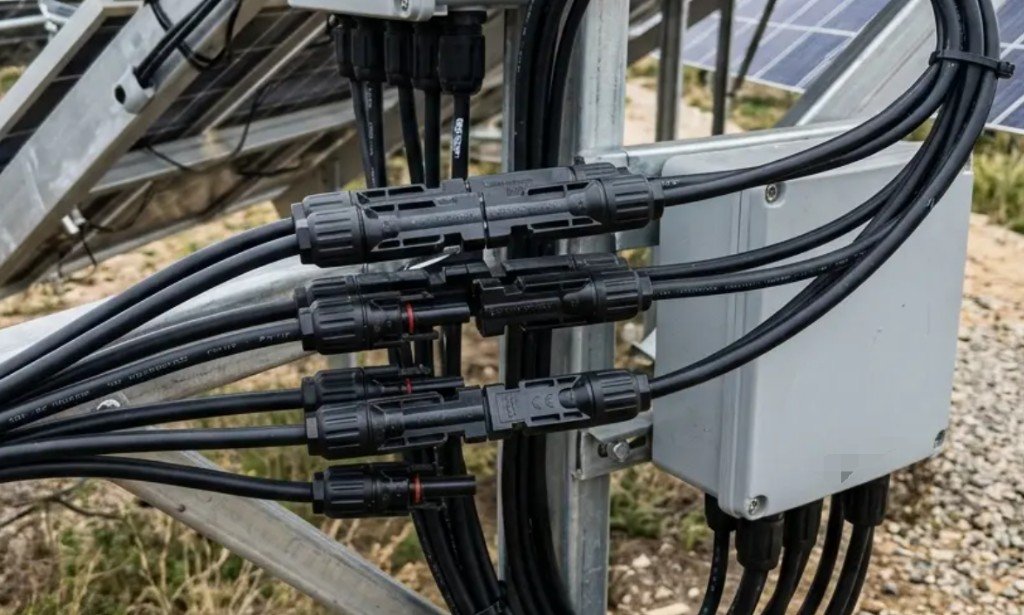
In 2026 the connectors on new solar panels are still a short list: Stäubli Original MC4, Stäubli MC4-Evo 2, Amphenol H4 and UTX, TE Connectivity SOLARLOK, and Phoenix Contact SUNCLIX. You choose by the name on the module, then by 1,000 V DC or 1,500 V DC, then by whether you own both halves of the joint. A table that adds a "solar power connector" at 1,200 V, rates H4 at 20 A, or calls a T4 part silicone, is not a specification. 1,200 V is not a system class used on photovoltaic strings. T4 is a model name some factories print on a 4 mm housing, not a material.
A 2025 paper from Sandia National Laboratories and NREL describes connector failure as the leading cause of fire in photovoltaic systems. The same paper asks the trade to stop saying "MC4-compatible" and to say "4 mm PV connector" instead, because the nickname is how two different brands get plugged together. That is the choice this page is about.
What is actually on a module in 2026
These families are not ranked. A connector that is not the one crimped at the junction box is the wrong connector, however tidy its row in a blog table.
| Family | Who makes it | Voltage you can use | How it is finished | Buy it when |
|---|---|---|---|---|
| Original MC4 | Stäubli | 1,000 V DC | Crimp, with the tool in the MC4 instruction | The module says Original MC4 and the string stays inside 1,000 V, including a cold morning |
| MC4-Evo 2 | Stäubli | 1,500 V DC | Crimp. Do not assume the older MC4 pliers fit the contact | The module is Stäubli and the array is a 1,500 V design |
| H4 and UTX | Amphenol | The series datasheet. UTX is the later 1,500 V family | Crimp, tool-release lock | The module or harness lead is Amphenol |
| SOLARLOK PV4 and SLK | TE Connectivity | 1,500 V class on the PV4 datasheets that say so | Crimp on PV4. Insulation displacement on SLK, still only onto the TE mate | The drawing names SOLARLOK |
| SUNCLIX | Phoenix Contact | 1,500 V class where the part is marked for it | Spring clamp or crimp, as that part is built | The equipment is Phoenix, or the crew must terminate without a hex die |
| A 4 mm compatible pair | Many factories, including ShineTong | 1,000 V or 1,500 V, and only the class printed on that SKU | Crimp, both halves from that one SKU | There is no factory lead. You are making an extension, a whip, or a branch |
Stäubli's letter of 14 October 2024 allows defined mates inside its own catalogue: original MC4 with MC4-Evo 2, Evo ready and Evo 2000. The pair keeps the lower rating. Original MC4 on one side of an Evo 2 body is a 1,000 V connection, not a 1,500 V one. MC4-Evo stor is a further split. Compatibility charts of the range show it keyed so it will not mate with the PV-string plugs. It is for the battery DC link. "Also Stäubli" is not enough.
H4 is not a softer MC4, and it is not rated at 20 A as a family. Amphenol publishes current by cable size, the same way everyone else should. There is no weather test in the public record that makes H4 "less robust" than MC4. Buy it when the lead is Amphenol. Leave it in the box when the lead is Stäubli.
Older MC3 parts, the 3 mm pin with no real lock, show up on repairs of old arrays. They are not a 2026 purchase for a new string.
Six checks, in the order that prevents a return
- Read the connector line on the module, the optimizer, and the microinverter. That line is the specification for every joint that touches a factory lead. Two module brands on one roof are two families. A Y-branch does not marry them.
- Match the voltage to the cold string, not to the brochure. Open-circuit voltage rises as the cells get colder. The connector class has to clear the same maximum the inverter input already has to clear, at the site's low temperature. A 1,000 V body on a string that climbs past 1,000 V in January is the wrong part even if the housings match.
- Match current to your cable size at a hot ambient. A single ampere number, 30 A or 20 A or 35 A, is not comparable across brands. Ask for the figure at 4 mm² or 6 mm² and at the upper temperature. A branch carries the sum of the strings it joins, not the current of one of them.
- Match the gland to the jacket you measured. Copper size and outer diameter are different. Two reels of 4 mm² cable to IEC 62930, or the older EN 50618 H1Z2Z2-K, do not share one jacket. The nut, the seal and the cable grip only work inside the band in the assembly sheet.
- Keep both halves in one family. From the 2020 NEC, section 690.33(C) requires a listed intermateable pair when the halves are not the same type and brand. IEC TR 63225 records that the installation standards already refuse a mix of manufacturers. A click is not that listing.
- Name the tool before the cartons ship. The die belongs to that contact. A ratchet sold as a universal MC4 crimper is how a certified contact becomes a loose one. Order positive and negative by the plus and minus on the housing. "Male" and "female" get swapped, because the metal pin and the plastic shroud point opposite ways.
The ratings worth reading, and the ones to ignore
Voltage is the first number, and it is only 1,000 V DC or 1,500 V DC on a normal string. IEC 62852:2014+A1:2020 allows connectors up to 1,500 V DC and 125 A per contact. That is the ceiling of the standard. It is not the rating of the part in your hand.
Current without a cable size and a temperature is advertising. In one Stäubli description, Original MC4 contact resistance is no more than 0.25 mΩ. That is a type-test on their contact. It is not a pass mark you can shop with, and it is not a promise that every 4 mm housing on the market measures the same. A blog that tells you to reject anything above 0.5 mΩ has invented a gate the standards do not use as a buying rule.
IP68, where it is printed, is a mated and locked test for a stated depth and time under IEC 60529. It is not a description of an open connector in a puddle, and IP67 is not a worse product if that is the test the certificate actually ran. Do not let a table "round up" IP67 to IP68 so the column looks even. Temperature range is the next line, often around −40°C to +85°C, and it has to be on the datasheet of the SKU, not borrowed from the row above.
Housing material is the polymer, not the contact. Stäubli lists polycarbonate and UL 94 V-0 for Original MC4 in that same description. Other families use PPO, PPE or polyamide. "Copper" in the material column of a comparison usually means the author put the contact metal in the housing cell. Silicone is a seal material on some glands, not the name of a connector family.
Weather is a seal problem, not a slogan
The joint lives outdoors for the life of the array. What fails it is water at the cable entry, a gland on the wrong jacket, a cracked locking tab, or UV-brittle plastic, not a missing paragraph about recycled housings. Ask for UV resistance only when a test or a material callout is attached. Ask for salt mist only on a coastal job, and only if the certificate names the test. A livestock shed or a fertilizer store is an ammonia question. If the datasheet is silent, the honest answer is "not claimed", not a greener adjective.
Inspect the ones you can see, at commissioning and when a string underperforms. Heat at a connector is a crimp, a mix of brands, or a loose gland. It is not a reason to replace the modules.
Pay for the name on the module, not for a percentage
No published study shows that a "quality connector" adds 25% to system life, or that a cheap one throws away 5% to 10% of annual energy, or that a new connector design lifts panel output by 5%. Those figures circulate in buying guides without a test behind them. Do not put them in a payback sheet.
The money is elsewhere. The connector is a small line on the bill of materials. The named family for a factory lead costs more than a lookalike and avoids a rejected inspection. The crimp tool costs more than a generic pliers and avoids the hot joint. A spare box from the same batch costs less than qualifying a second batch two years later, which is the warning in IEC TR 63225: materials change, and a one-time mix test does not follow the factories. A truck roll to a roof, or a burned housing, costs more than the difference between two unit prices. Sandia's fire finding is the cost model. A fictional loss percentage is not.
On a short home run the cable, not the connector, is the loss you can calculate. Fifteen metres each way is 30 m of copper. At 12 A, using 58 as the copper factor near 20°C, 4 mm² loses about 19 W and 6 mm² about 12 W. On a string near 4 kW that is under half a percent either way. A hot roof and the resistance on the cable datasheet both push it up. For a house, 4 mm² is usually enough. For a long trench, 6 mm² earns the copper. Then buy the connector that accepts that jacket. The connector choice does not move those watts. A bad crimp can, locally, as heat.
What 2027 changes, and what it does not
The product standard is about to say plainly what installers are already told. BEAMA quotes subclause 5.3.2 from the draft of the next IEC 62852: both halves shall be from the same product family of the same manufacturer, and the standard does not cover mixes, even if two makers promise to warn each other about changes. That sentence is not in the current edition, BS EN 62852:2015+A1:2020. Waiting for publication before you stop mixing is the wrong way around. The installation rules already forbid it.
Nothing in that draft creates a smart connector, a USB panel plug, or a new 1,200 V class. Monitoring of a string already lives in the inverter. Lightweight housings do not retire the lock, the seal, or the rule that the module lead picks the family. If a pitch for 2027 cannot name a standard clause or a part number, it is not a buying reason.
ShineTong, on the joints that have no factory lead
ShineTong supplies 4 mm connectors for the row in the table where both halves are yours. We do not sell Original MC4, H4, SOLARLOK or SUNCLIX, and we do not claim those leads will mate with ours. Send the words printed on the module. If they name another maker, that line stays off the quote.
- ST-MC4-1500 is the 1,500 V DC pair, IP68 when mated, PPO/PPE housing, tin-plated copper, cable 2.5–10 mm². Current is published as 30–50 A depending on the contact and the cable. Use the figure for your cross-section, not the top of the span.
- ST-MC4-50A is up to 50 A at 1,000 V DC, for 2.5–6 mm². It is the wrong body for a 1,500 V string.
- ST-MC4-T and ST-MC4-Y are branches in the same family. They carry the summed current, at 1,000 V or 1,500 V according to the SKU.
TÜV and CE documents are optional per order and have to name the part. We do not quote UL 6703. A project that requires that listing needs a family that holds it. There is no public price. How to compare the paperwork and the die is in the supplier check for EPC orders. What the pin, the gland and the lock actually are is in what a 4 mm connector is.
Send the connector name on the module, the string voltage, and the cable size.
Frequently asked questions
Are MC4 connectors still the ones to buy in 2026?
Original MC4, yes, when the module says Stäubli and the string is within 1,000 V DC. For a 1,500 V Stäubli module the part is MC4-Evo 2. If the module says Amphenol, TE or Phoenix, MC4 is the wrong name even though people use it for every 4 mm plug.
Is the H4 connector better than MC4?
It is better only when the factory lead is an H4 or a UTX. It is not a higher-voltage upgrade for a Stäubli lead, and it is not a 20 A connector as a category. Compare the datasheet of the exact series, at your cable size. Do not compare a blog table that gives every family one ampere number.
What IP rating should a solar connector have?
The rating on the certificate for that part, in the mated condition, IP67 or IP68 as tested. IP68 is not automatic, and it does not apply to a connector left open or to a gland that does not fit the jacket. Match the test that was run. Do not prefer a higher number that nobody certified.
Do cheap connectors waste 5% to 10% of the power?
That percentage is not a measured result. On a normal home run, even the difference between 4 mm² and 6 mm² cable is well under one percent. A bad connector shows up as a hot joint, a failed string, or a burned housing, which is a reliability cost. It does not shave a tidy slice off the annual yield.
Can I mix connector brands if they click?
No. Stäubli forbids third-party mates with Original MC4. Installation standards and NEC 690.33(C) require the same type and brand, unless that exact pair is listed for intermateability. The draft of the next IEC 62852 says the same thing inside the product standard. A compatible connector is legitimate when both halves are that connector.
Documents
- DiGregorio and colleagues, Sandia and NREL, Solar Energy 2025 — 4 mm PV connectors, and why "MC4-compatible" causes cross-mating
- Stäubli, 14 October 2024 — which of its own MC4, Evo 2, Evo ready and Evo 2000 parts may mate
- Stäubli — Original MC4 at 1,000 V DC, MC4-Evo 2 at 1,500 V DC, polycarbonate housing, contact resistance
- BEAMA — draft IEC 62852, both halves from the same family and the same manufacturer
- IEC TR 63225:2019 — connectors from different manufacturers are not an intermateable pair
- Stäubli-range chart, 28 October 2024 — the lower rating governs, and Evo stor does not mate with the PV string
