- What you are comparing
- The mating rule ends most quotations
- Read the certificate, not the stamp on the photo
- Current, voltage, and the cable you will actually pull
- The crimp tool is part of the product
- What the EPC file has to contain
- A quotation you can actually compare
- Where ShineTong fits
- Related reading
- Frequently asked questions
- Can an MC4-compatible connector plug into a Stäubli module lead?
- Is a TÜV test report the same as a certificate?
- How do I compare current ratings between suppliers?
- Does the supplier have to provide the crimp tool?
- What should be in the handover for the connectors?
- Sources
Compare an MC4 connector supplier on three things: the certificate names the part you are buying, the mating rule matches the module lead on the drawing, and the crimp tool is specified for that contact and that cable. Unit price is the last column. A connector that clicks onto a module lead is not a certified joint, and on an EPC job that joint is the one an inspector, an insurer and a warranty claim will all ask about.
Original MC4 is a Stäubli product. "MC4" in a tender usually means the familiar 4 mm single-contact DC plug, and half the market sells something that fits the shape. Fitting the shape is the start of the comparison, not the end. Last updated: October 2026.
What you are comparing
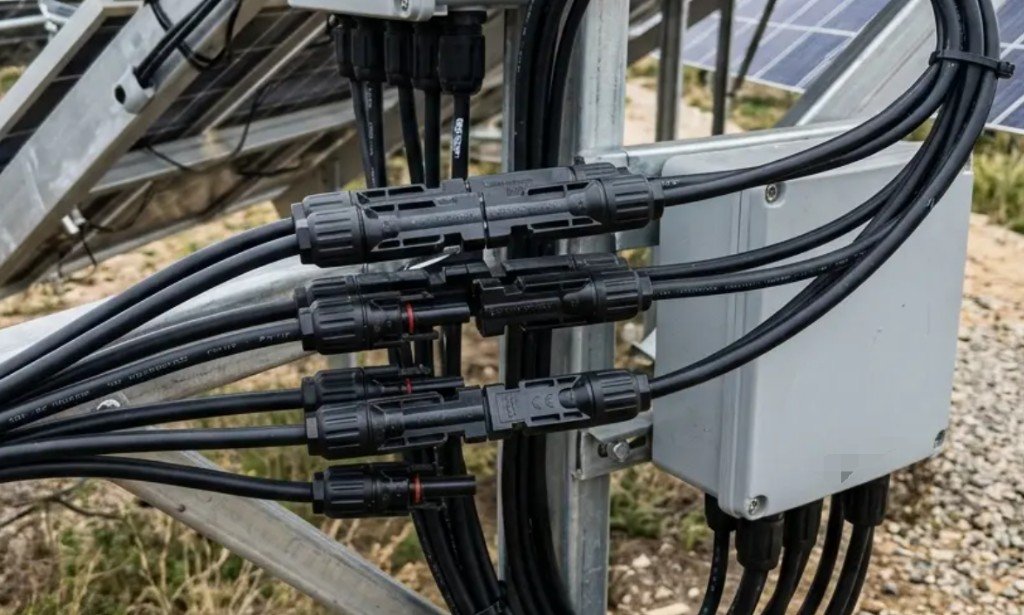
A field photo of a rack tells you why this is an EPC problem and not a catalogue problem. One post can carry module leads, extension whips, a branch, a homerun into a junction box, and spare tails tied back for the next row. Each of those is a mated pair that will sit in sun, wind and rain for twenty years. The supplier who won on a cent per piece is invisible until one of those pairs runs hot.
So the object of the comparison is not a plastic housing. It is a mated pair from one product family, the tool that terminates it, the cable gland that matches the jacket you will pull, and a document pack an owner's engineer can file. If a quotation gives you a unit price and a photo, you do not yet have a bid.
The mating rule ends most quotations
IEC 62852:2014+A1:2020 is the product safety standard for DC connectors in photovoltaic systems, up to 1,500 V DC and 125 A per contact. Those ceilings belong to the standard, not to the part in the box. The standard tests a connector with its own counterpart. It is not an intermateability standard. IEC TR 63225:2019 says this in plain language, and it records that the installation standards IEC 62548 and IEC 60364-7-712:2017 do not allow DC connectors from different manufacturers to be connected together. The report also says a claim of "MC4-compatible" is potentially misleading, because it suggests a safe mix that the standards do not give you.
The reasons in that report are mechanical, not commercial. Different alloys, different contact geometry, unspecified tolerances, and different plastics expand and age differently. A pair that measures fine on day one can loosen, take on water, and heat up years later. A supplier can also change a material after the day someone tested a mix, so a compatibility letter from last year does not govern the batch on the boat.
Stäubli's own position matches the report. Its assembly instructions tell installers not to plug third-party parts, including parts advertised as MC4-compatible, into Original MC4 or MC4-Evo 2. A one-time laboratory cross-mate test is not a design certificate. The test house tested the samples it was sent. It does not follow the two factories afterwards. If the mix fails in the field, the connector makers point at the instructions, and the installer is the one holding the claim.
On a US project the same rule is in the code. From the 2020 NEC, and still the rule installers are held to, section 690.33(C) says that where mating connectors are not of the identical type and brand, they shall be listed and identified for intermateability in the manufacturer's instructions. UL 6703, as a 2024 Sandia briefing summarised it, evaluates connectors with mating parts of the same brand unless more than one manufacturer submits them together to prove they may be mated. A sentence on a datasheet is not that submission.
Apply it on the drawing before you apply it to the price.
- Module to anything. The lead on the junction box is already a brand. Read the module installation manual. If it names Stäubli, Amphenol, TE or another specific connector, the field half that plugs into that lead has to be the one that manual allows. A cheaper lookalike fails this line even if it locks.
- Field to field. Extension to extension, whip to combiner, branch to homerun: both halves from one family, one factory, one certificate. This is where a compatible connector is a legitimate buy, because you own both sides.
- Do not "solve" a mismatch with an adapter unless that adapter is itself the listed method. Every extra pair is another contact resistance and another seal.
Read the certificate, not the stamp on the photo
A logo moulded into a nut is a mark. A certificate is a file. Open the file and check four lines before you compare anyone's price.
- The part number. It has to be the SKU on the purchase order. A certificate for a different series, a different voltage class, or a factory you are not buying from is a certificate for a product you are not installing.
- The voltage. 1,000 V DC and 1,500 V DC are different parts. A 1,500 V string on a 1,000 V connector is a fail on paper, even when the housings are identical and the latch clicks.
- The current, at a cable size and a temperature. "30 A" or "50 A" with no cross-section is not a rating you can design to. The contact, the copper and the ambient decide the number. Ask for the table.
- What kind of document it is. A design certificate, with the factory under surveillance, is what you file. A sample test report describes the pieces that were posted to the lab. A cross-mate report is the weakest of the three, and Stäubli says outright that it must not be read as approval to mix brands.
For an IEC project, ask for IEC 62852 from a named body, and read the model list on the certificate rather than the word "TÜV" in the email. For a project that has to satisfy UL and the NEC, ask for UL 6703 and for the module manual's connector list. CE on a housing is not a substitute for either.
Then match the factory. The address on the certificate should be the address you are auditing or, if you are not auditing, the address on the commercial invoice. A certificate held by a trading company for a factory it will not name is a gap, not a detail.
Current, voltage, and the cable you will actually pull
Write the string down before you write the connector down. Maximum system voltage, maximum circuit current, copper size, and the measured outer diameter of the jacket. The copper size picks the contact. The jacket diameter picks the seal. They are not the same number.
IEC 62930 photovoltaic cable, and the older EN 50618 cable still on many sites, is specified by conductor size, but two reels of 4 mm² do not have to share one jacket diameter. If the gland is too loose, the IP rating on the datasheet never happens in the rain. If it is so tight the installer slits the seal to get it on, you have the same result. Ask every supplier for the jacket range in millimetres, then measure your reel. Reject the bid that only says "4 to 6 mm²".
IP68, where it is claimed, is a mated and locked condition under IEC 60529, for a stated depth and time. It is not a promise about an open connector left in a puddle overnight, and it is not a promise about a connector whose nut was never tightened. Some housings are marked IP67. Do not let a bidder "round up" to IP68 in the comparison sheet because the other bidder wrote IP68.
Branch connectors need one extra line. A Y or a T that parallels two strings carries the sum of the currents, not the current of one string. A branch sold as "the same 30 A as the inline pair" is undersized the moment both strings are producing. Put the combined current on the RFQ and make the supplier mark which SKU is the branch.
Housing and plating are worth a line each, and no more than the certificate supports. PPO or PPE, a UL 94 V-0 flame class if it is actually stated, tin-plated or silver-plated copper if the datasheet says which. "Marine grade", "anti-UV" and "ammonia resistant" are sentences until a named test or a certificate annex says them. Coastal plant and livestock roofs are real environments. They are not a reason to accept an adjective.
The crimp tool is part of the product
IEC 62852 points at the crimp rules in IEC 60352-2. The connection you are buying is the contact after it has been crimped with a defined die, not the contact in a bag. A generic ratchet sold as an "MC4 crimper" often uses the wrong hex, the wrong locator, or no locator at all. The strands fold, the pull-out force collapses, and the joint heats under current that the datasheet said was fine.
On the comparison sheet, a supplier passes this line only if they name the tool and the die for each contact and each cable size, and if they will crimp your cable, not a cable of their choosing. Section one sample. You are looking for a crimp that holds the strands across the barrel, a pull-out result against the number in their own instruction, and a contact resistance against the limit in that same instruction. If they have no number, they do not have a crimp specification.
Also decide who crimps. Factory-crimped whips move the skill into a place you can inspect before shipment. Field crimps are right when the homerun length is not known until the trench is in, and they require the tool on the site, a trained crew, and a hold point in the quality plan. A supplier who sells loose contacts and shrugs at the tool has left you the failure mode.
What the EPC file has to contain
Procurement is finished when the handover folder is finished. For each connector family on the job, the folder should hold:
- The datasheet, with voltage, the current table by cable size, ambient range, IP rating and the condition it applies to, housing material, and contact plating.
- The certificate, the part numbers it covers, the factory, and the expiry or surveillance status.
- The assembly instruction, including the tool part number, strip length, and the torque or the nut position for the gland.
- A mating statement in the maker's words: which counterparts are allowed. "Only our own male and female" is an acceptable statement. "Compatible with all MC4" is not.
- Batch codes on the connector body and the same codes on the packing list, plus a retained sample from the shipped lot.
- For the module joint, the page of the module manual that names the allowable connector.
Keep male, female, branches and spares from that lot. A later "equivalent" batch is a new qualification, which is the point IEC TR 63225 makes about materials changing after a one-time test. Extra pieces from the shipped batch are cheaper than qualifying a second batch later. How many extras is a site decision. The principle is not.
A quotation you can actually compare
Send every bidder the same sheet. System voltage, maximum circuit current, copper size, measured jacket diameter, the module connector brand and model, and whether each line is a module joint or a field joint. Add ambient, and say if the site is coastal or next to livestock. Ask for pairs, for the branch polarity you drew, and for the tool. Then score them on the same rows.
| Line | Accept | Send back |
|---|---|---|
| Certificate | Part number, factory and voltage match the line item | A logo, a different SKU, or a sample report offered as approval |
| Voltage | The part is rated for the string, 1,000 V or 1,500 V as designed | A 1,000 V body on a 1,500 V string because it "fits" |
| Current | A figure at your cable size and the upper ambient | One ampere number with no cross-section |
| Branch | Rated for the summed current, polarity as drawn | An inline rating copied onto a Y or a T |
| Mating | Own counterpart only, or a pair listed for intermateability | "MC4-compatible" with every brand on the roof |
| Module joint | The connector the module manual names | A third-party plug on a named Stäubli, Amphenol or TE lead |
| Tool | Die and locator named, sample crimped on your cable | "Any MC4 tool" |
| Seal | Jacket range covers the reel you measured | Copper size only |
| Traceability | Batch on the body and on the packing list | Unmarked housings |
Price the accepted rows only. A bid that fails the module joint is not cheaper. It is a different, non-compliant design. Two acceptable field-joint bids can then be compared on lead time, whether both genders ship from one lot, and whether the tool is included or has to be bought as a separate line that someone will "find on site".
Comparing connector bids for a live EPC package?
Where ShineTong fits
ShineTong supplies MC4-compatible connectors. We do not sell Original MC4, and we do not claim a listing that lets our housing mate with Stäubli, Amphenol or TE. If the module manual names one of those, that joint is not our part. Say so in the inquiry. We would rather lose the module-lead line than ship a plug that only fits.
Where both halves are specified as one family, we will quote. That is extension cable, combiner whips, homeruns you terminate yourself, and branch connectors in that same family, bought together so the lot matches. The published range, which the quotation has to pin to a part number, is:
- ST-MC4-1500: 1,500 V DC, IP68 when mated, PPO/PPE housing, tin-plated copper contacts, cable 2.5–10 mm². Current is published as 30–50 A depending on the contact and the cable. Do not treat that span as the rating of every size. Ask for the ampere at the cross-section you are pulling.
- ST-MC4-DUAL: 1,000 V and 1,500 V classes, 2.5–10 mm², ambient −40 to +85°C, UL 94 V-0 on the published card. Pick the voltage class. Do not let a dual-series label stand in for a 1,500 V certificate if the line item is the 1,000 V body.
- ST-MC4-50A: up to 50 A, and the published voltage is 1,000 V DC, for 2.5–6 mm². It is the wrong part for a 1,500 V string. "Up to 50 A" is a ceiling, still to be confirmed at your cable size.
- ST-MC4-T and ST-MC4-Y: T and Y branches, 1,000 V or 1,500 V depending on the SKU, typically 4 mm² and 6 mm². Send the polarity drawing. The branch has to carry the summed current.
- ST-MC4-KIT: mixed cartons, with OEM bag and carton marks when you need your own brand on a stocking order.
TÜV and CE documents are options on a given order. The quotation will say which certificate covers which part number. We do not quote a UL 6703 listing. If the project is a US job that requires that listing, this range is not the answer, and we will tell you that before anything is packed. There is no public price list. Cable for the same shipment is quoted from the PV cable range so the jacket can be checked against the gland, instead of assuming two catalogues agree.
The basics of the part itself are in what an MC4 connector is. A brand list is a different job from this check, and it does not replace the certificate or the mating rule.
Need pairs, branches and a document pack for one lot?
Send the voltage, the cable size, the jacket diameter and the module connector brand. We will say which lines we can supply, and which lines we should not be on.
Related reading
- What an MC4 connector is
- Solar connector manufacturers, as a brand list rather than this check
- ShineTong MC4-compatible connectors
- PV cable
- Combiner boxes, where the homerun connector has to match the whip
Frequently asked questions
Can an MC4-compatible connector plug into a Stäubli module lead?
It will often click. That is not approval. IEC 62852 certifies a connector with its own mate, and IEC TR 63225 says installation standards do not allow mixing manufacturers. Stäubli tells installers not to mate third-party "MC4-compatible" parts with Original MC4. On a US job, NEC 690.33(C) requires a listed intermateable pair if the two halves are not the same type and brand. Use the connector the module manual names for that joint.
Is a TÜV test report the same as a certificate?
No. A design certificate names the part numbers, the factory and the surveillance. A test report describes the samples that were sent, on that date. A cross-mate report is narrower still: it does not put the factory under surveillance, and it does not make a mixed pair into a listed connection. File the certificate. Treat the other two as background, not as the approval.
How do I compare current ratings between suppliers?
At the same copper size and the same upper ambient, on a 1,000 V or 1,500 V part that matches the string. A single "50 A" headline is not comparable to a table that gives 30 A on 4 mm² at the top of the temperature range. A 50 A part published at 1,000 V DC is not a substitute for a 1,500 V connector. Ask for the derating table if the cable will sit on a hot roof rather than in a lab at 25°C.
Does the supplier have to provide the crimp tool?
They have to name it, and the die has to belong to that contact and that cable size. You can buy the tool from them or from the tool maker they specify. What fails the comparison is "use any MC4 crimper". The wrong die is how a connector that passed a type test becomes a hot joint in a trench. Have one sample crimped on your own cable and sectioned before you approve the lot.
What should be in the handover for the connectors?
Datasheet, certificate for the SKU that shipped, assembly instruction with the tool number, a mating statement, batch codes that match the packing list, and the module-manual page for any joint on a factory lead. Keep a retained sample from the shipped batch. A later delivery under a similar name is a new check, not an automatic repeat of this one.
Sources
- IEC 62852:2014+AMD1:2020, connectors for DC application in photovoltaic systems
- IEC TR 63225:2019, incompatibility of connectors for DC application in photovoltaic systems
- Stäubli, avoid cross-mating PV connectors from different manufacturers
- Stäubli, cross-mating, product liability, and why a one-time test is not a certificate
- Sandia, connector failures, NEC 690.33(C), UL 6703 and UL 62852 (2024 briefing)
