Half-cut cells are ordinary cells sliced in half. Each half has about the same voltage as the original cell and about half the current, because current scales with area and the slice removes half the area. Module makers then wire those halves into paths that usually appear as two groups side by side in one frame. The current inside each path is lower than it would be in a single series string of full cells built for a similar module current. Lower current in the internal ribbons is the electrical change. Everything else people claim has to be checked against the datasheet of the module in front of you.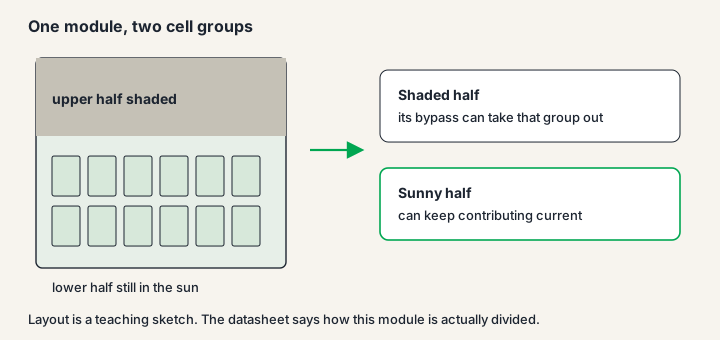
What the cut changes inside the laminate
A full-cell module of the older pattern puts its cells in one series chain, broken into groups only where a bypass diode sits. A half-cut module of the common pattern puts two such chains in the same frame and joins them so the module current is the sum of the path currents. The diode map follows the groups the maker drew. Some modules use more than two groups. The drawing in the datasheet is the drawing that matters. A brochure that says half-cut and omits the diode map has told you the cell size and withheld the circuit.
Because each path carries less current, the resistive loss in the cell interconnects is smaller than it would be at the higher current of a single path. Manufacturers build the product that way for that reason. This page will not turn the loss reduction into a percent of annual energy. Annual energy also depends on the site, the inverter, the temperature, and how the module is shaded. A flash-test wattage on the nameplate already includes whatever circuit the maker settled on. Compare nameplates if you are comparing products. Do not add a bonus the nameplate never showed.
The string those modules join is still a string: series voltage adds, and the inverter's window still has to contain it on the coldest morning the design cares about. Half-cut construction does not repeal that arithmetic. How a string is defined, and why one module's internal groups are not the same thing as several strings, is in what a solar string is.
Shade on one half can leave the other half in the circuit
When the module really is two groups, a shadow that the bypass diode isolates to one group takes that group out and leaves the other group's path able to produce. A single series chain of full cells puts every cell in one path, so the diode that saves the string also removes every cell in its group, and a shadow across the short edge of the module can knock out more of the nameplate. The shade mechanisms, including how bypass current flows, stay with how shade affects PV output. The diode faults that undo this arrangement are in when a bypass diode fails.
The benefit is conditional. A shadow that covers both groups, a uniform dirt film, or a tree that darkens the whole module removes the advantage of having two paths. A portrait module and a landscape module put the groups on different axes, so the same railing shadow hits them differently. Orientation is part of the design. Half-cut is not a charm against shade. It is a circuit layout that limits how much of the module one local shadow can remove, when the shadow lines up with that layout.
What the label still has to prove
Read the cell count, the number of diode groups, and the electrical ratings at the stated test conditions. Two half-cut modules with the same marketing sentence can have different voltages and different diode maps. Mechanical ratings, the frame, and the connector are unchanged questions from any other module. A half-cut cell is smaller, and the module may contain roughly twice as many pieces of silicon. That raises the number of solder joints. It does not, on this page, become a reliability percentage. The warranty and the field record of that bill of materials answer reliability. The cut answers the current in each path.
If a proposal promises a gain in yearly kilowatt-hours specifically because the cells are half-cut, ask for the two production cases that differ only in that construction, at your tilt and your shade. If the seller cannot separate the cell cut from a larger module, a different inverter, or a sunnier assumption, the percent is not evidence. Buy the nameplate you can read.
