Living off grid with solar means the house, cabin or clinic has no utility to cover a bad week. The design month is the one with the least sun and the load you still refuse to drop. A yearly average of sunshine will size a system that works in May and goes dark in January.
Updated October 2026. The numbers in the worked example are an illustration for an assumed 100 watt average load. They are not a recommendation for a specific house.
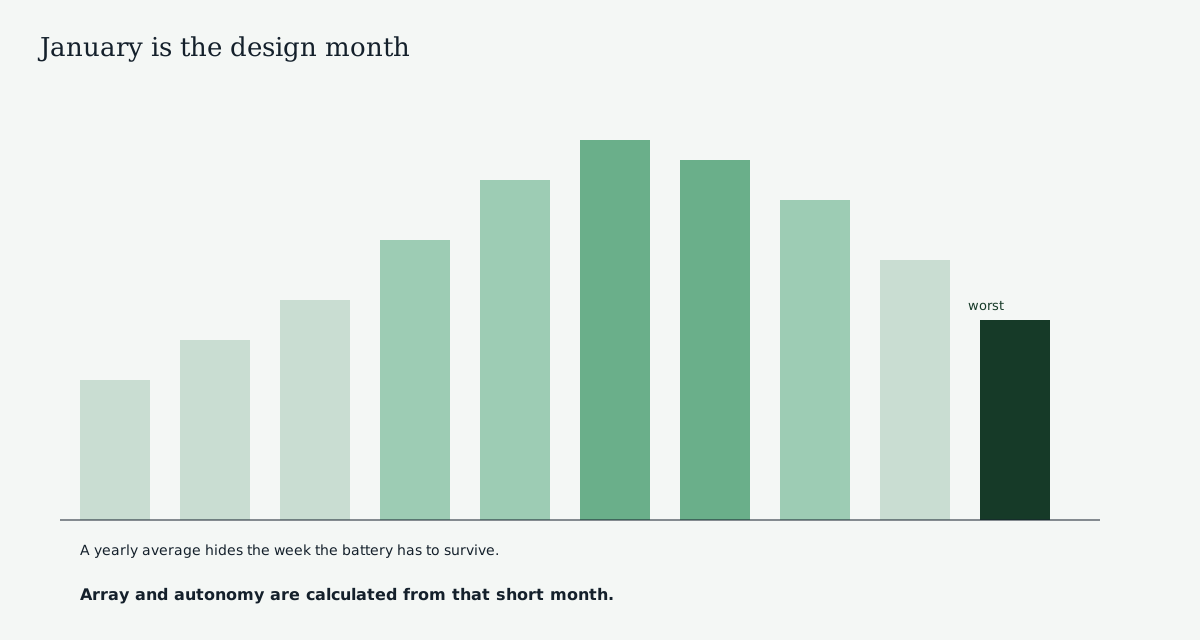
Start from the worst week you are willing to sit through
Missouri Extension defines an off-grid solar system as one that is not connected to the utility. The electricity is stored in batteries, the sites are often remote because a grid extension costs more than the solar, and a generator or a small wind turbine usually sits beside the array. That last part is the part people skip when they picture a silent, self-sufficient roof. The generator is how a full-time home survives the week the battery was not sized for. Some jurisdictions also require a utility connection before a house may be occupied. That is a local rule. Ask the authority that issues the permit before you plan a life that assumes the grid is optional.
A weekend cabin can be designed to go dark, or to start a small generator, after two cloudy days. A house with a fridge and a water pump generally cannot. Full-time off-grid designs often carry three or more days of autonomy for that reason, and still keep a generator. Fewer days can be honest if someone is there to run the generator and to shed load. More days can be honest in a monsoon or a northern winter. The number is a choice about inconvenience, fuel and money.
One arithmetic, labelled as a method
Write the daily energy from the loads you will actually run, in watt-hours. An average of 100 watts across the day is 2,400 Wh. It is also a very small house: lights, a router, phone charging, a modest fridge if you are careful. An electric kettle or a pump used for an hour changes the total faster than another light bulb does.
The array has to replace that energy on the worst month’s sun, after losses. A planning factor around 0.75 is a common way to bundle heat, dust, wiring and a battery that is not brand new. It is a factor, not a law. If the worst month offers 3.5 full-sun hours:
2,400 Wh ÷ (3.5 h × 0.75) ≈ 910 W of array.
Designers often add margin so the battery can recover after it has been drawn down, which is how a load like this one moves from about 910 W toward 1 to 1.2 kW. Use your own sun hours. A coastal desert and a wet highland do not share 3.5.
The battery covers the days you decided to ride through, and only the share of its nameplate you are willing to use. For three days, 2,400 Wh each, and 80% of a lithium pack treated as usable:
2,400 × 3 ÷ 0.8 = 9,000 Wh, or 9 kWh.
Lead-acid used at a shallower depth needs a bigger nameplate for the same job. A lithium pack you only cycle to 50% because you are nervous also needs a bigger nameplate. The 9 kWh figure is this example at 80% usable, not a product size.
The habits that keep the arithmetic true
Run the large loads at noon, when the array can carry them and the battery is a passenger. A washing machine at 8pm is a withdrawal from tomorrow morning’s lights. Watch state of charge over a week, not over an afternoon. A pack that is lower at dusk each day is a sizing problem even if the lights still work tonight. Clear the modules. A month of dust is a silent cut to the 0.75 factor you already spent.
Flooded lead-acid still needs water and a ventilated place away from the rooms people sleep in. Lithium does not want a charge below 0°C unless the pack heats itself. The chemistry choice is laid out in solar battery types. Whichever you buy, the generator deserves the same maintenance hour as the battery. A generator that will not start is not a backup.
Frequently asked questions
How many days of storage should an off-grid house have?
Enough for the cloudy stretch you refuse to manage with a generator or by switching loads off. Three days is a common planning point for a full-time home. A cabin that someone can shut down, or a site with a reliable generator, can carry fewer. The battery equation above shows what “fewer” and “more” do to the kilowatt-hours.
Does adding more panels remove the need for a generator?
More panels help the battery recover on a bright day after a storm. They do not help on the third day of thick cloud, because there is nothing to convert. That is the week the generator, or a smaller load, is the design.
Sources for the definitions
Off-grid as a system with batteries and, typically, a generator or wind beside the solar: University of Missouri Extension, solar system options (PDF). Where a fuel generator sits in a formal off-grid design: VeraSol installation guidelines (PDF). The watt-hour arithmetic is the method in the article, applied to an assumed 100 W average and assumed sun hours. Replace both with the site’s own figures before anyone buys a battery.
