- Five chemistries, one line each
- The fact sheet often stops at the family name
- LFP is the pack that expects a cycle most days
- NMC is the lighter lithium, and it is leaving the garage
- Lead-acid still shows up where the budget is the constraint
- Flow batteries are a site technology
- Sodium-ion is a watch item
- What to ask before the chemistry argument ends
- Where the labels come from
When a home-battery sheet says only “lithium-ion”, it has not told you which battery you are buying. The two lithium types sold for houses, LFP and NMC, share a family name and then diverge on weight, cycle life and how they behave when they are hot. Lead-acid is a different machine again. Flow batteries are tanks and pumps. Sodium-ion is still mostly a laboratory and pilot story for homes.
Updated October 2026. Warranty cycle counts below are the figures named by one US marketplace page for specific brands. Lab ranges are from a Sandia cell study. They are not interchangeable.
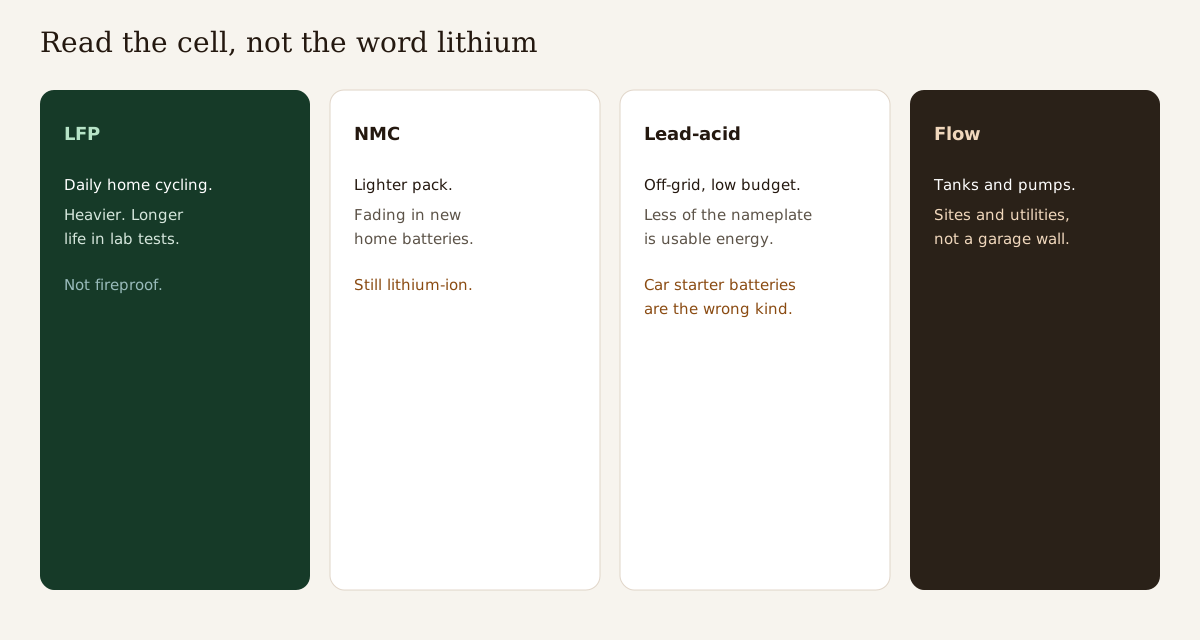
Five chemistries, one line each
The rows below are a reading aid for the sections that follow. A cycle count from a lab and a cycle count from a warranty are different documents. They sit in the same column only so you can see which number belongs to which chemistry.
| Chemistry | The job it fits | The figure you can check |
|---|---|---|
| LFP | Daily cycling in a house. Heavier for the same energy. | Sandia’s cell tests: about 2,500 to 9,000 equivalent full cycles. Many cells were still above 80% when the paper closed. |
| NMC | A lighter pack, or an older home battery still in service. | Sandia: about 200 to 2,500 equivalent full cycles. Solar.com’s reading of one Generac warranty: about 10 years or 2,500 full cycles. |
| Lead-acid | A small off-grid site, if someone will maintain it. Not a car starter battery. | Solar.com’s summary for large cells: about 1,400 to 2,000 cycles. Flooded types need water and ventilation. |
| Flow | A site or a utility. Energy sits in tanks. Awkward in a hallway. | NSW notes a long hold time, lower energy density than lithium-ion, and a higher cost. |
| Sodium-ion | A technology to watch. Not a house battery to buy on a current quote. | Solar.com’s types article found none on California’s certified equipment list. |
The fact sheet often stops at the family name
NSW’s current battery guide says lithium-ion is the common chemistry in home solar batteries, and that the two types you will meet are NMC (nickel manganese cobalt) and LFP (lithium iron phosphate). It also says most fact sheets only print “lithium-ion”, so you have to look the model up. That lookup is the whole job. A pack can be a good LFP or a tired NMC and still carry the same three words on the cover.
The same NSW page says the industry has been moving toward LFP because it lasts, while good units still exist in both types. Solar.com, reading the installers on its own marketplace, goes further: more than nine in ten of those installers who sell batteries list at least one LFP model, and about one in twenty list an NMC model the writers could confirm. Treat that as their shop window in 2026, not as a census of every country.
LFP is the pack that expects a cycle most days
LFP uses an iron-phosphate cathode. It is heavier for the same energy, which is a small complaint on a garage floor and a large one in a car. For a house that shifts solar into the evening, the cycle count is the spec that matters.
Sandia National Laboratories tested commercial cells across temperature, depth of discharge and discharge rate. In that matrix the LFP cells delivered roughly 2,500 to 9,000 equivalent full cycles, and many had not yet fallen to 80% of their starting capacity when the paper closed. The NMC cells in the same style of test delivered roughly 200 to 2,500. Temperature and how hard you cycle move the result as much as the letters on the cell. A shed at 45°C is not the lab.
Solar.com’s types page gives a warranty example, not a lab result: Enphase’s cover, as they report it, is 15 years or 6,000 cycles. A brochure “6,000 cycles” still needs the small print. Ask what capacity is left at the end, at what depth of discharge, and whether the warranty pays on years or on energy throughput, whichever comes first. A closer look at the two lithium cathodes is in LFP and NMC for a house battery.
NMC is the lighter lithium, and it is leaving the garage
NMC stores more energy per kilogram. That is why it dominated cars. On a wall, the weight saving rarely pays for a shorter life. Solar.com names Generac’s warranty, as they read it, at about 10 years or 2,500 full cycles, and notes that older home batteries such as the Powerwall 2 used NMC while newer home lines have moved to LFP. If a quote still specifies NMC, ask why: a weight limit, a leftover model, or a datasheet that has not been updated.
Neither lithium chemistry is fireproof. A 2023 study of 21700 cells in Batteries found that LFP reacted later and more slowly than NMC and NCA under heat and nail tests. The electrolyte in both can burn. NSW’s older printed guide already said overall build quality matters more than the chemistry slogan. Put the pack where the manufacturer allows it, and do not charge a lithium battery below 0°C unless the pack heats itself.
Lead-acid still shows up where the budget is the constraint
NSW’s 2020 home-battery guide described lead-acid as the chemistry off-grid systems had been using, and listed the reasons it fits that job poorly if you can afford lithium: it wants a full charge regularly, it is heavy, cycle life is shorter, flooded types need water and ventilation. Solar.com’s 2026 marketplace reading is that lead-acid is now rare outside off-grid, and that large lead-acid cells are often talked about in a band of roughly 1,400 to 2,000 cycles, with fewer for small 12-volt blocks. Those cycle numbers are that page’s summary. Usable energy is also lower than the nameplate. A starter battery from a car is the wrong object entirely: it is built for a short burst, not for a nightly discharge.
Lead-acid remains a rational buy when the site is small, the capital is tight, and someone will actually maintain flooded cells. It is a weak buy as a daily grid-tied home battery in 2026.
Flow batteries are a site technology
A flow battery stores energy in liquid tanks. Power (the stack) and energy (the tanks) can be sized apart, which is attractive for a long-duration installation and awkward in a hallway. NSW notes the safety and the long hold time, and also the lower energy density and the cost. Solar.com’s types page puts flow batteries with businesses and utilities, and says the liquid can last a long time while pumps and stacks are serviced on a shorter cycle. None of that is a home product you should expect on a residential quote.
Sodium-ion is a watch item
Sodium-ion removes lithium from the cathode story and is being piloted because sodium is abundant. Solar.com’s check, as of their types article, found no sodium-ion model on California’s list of certified battery equipment. Until a unit has a warranty, a listed certification for your market, and an installer who has hung one, it is a technology update, not a house battery.
What to ask before the chemistry argument ends
- Which cathode is in this model, written as LFP or NMC, not “lithium”?
- Usable kilowatt-hours, and the power in kilowatts, as separate numbers?
- Is the warranty years, cycles, or throughput, and what capacity remains?
- Where may it be installed, and what happens if the room drops below freezing?
Where the labels come from
NSW’s owner guide: Guide to owning a battery. The 2020 chemistry notes: NSW Home Solar Battery Guide (PDF). Marketplace types and the warranty examples: Solar.com, types of solar batteries. Sandia cycle tests: Preger and colleagues, OSTI 1650174. Heat and nail tests: Batteries, 2023.
