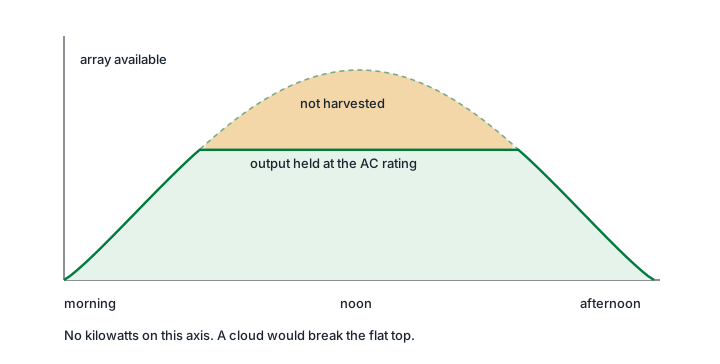
Inverter clipping is what happens when the photovoltaic array’s available DC power is above the inverter’s AC rating, and the inverter holds its output at that rating instead of converting the extra. The extra is not stored. It is simply not harvested during those hours. Clipping is a sizing outcome, not a fault code and not a broken panel. It is also not free waste in every case. A modest amount of clipping on the brightest hours can be the result of an array sized to produce more in the morning, the afternoon, and the cooler months, when the inverter is nowhere near its ceiling. The mistake is treating clipping as either always wrong or always fine without looking at how many hours it actually happens.
What inverter clipping looks like
On a clear day the power curve rises, flattens at the inverter’s maximum, and falls again. The flat top is the clip. A cloud breaks the flat line, which is how you tell it from an inverter that is derating for heat and from a string that has failed. Heat derating can also flatten a curve, and it should be separated from clipping by the inverter temperature and by whether the ceiling sits at the nameplate AC rating or below it. Heat is in how heat affects a solar module. A flat line that is far below the AC rating is not clipping. It is a limit somewhere else: shade, a disconnected string, or a thermal fold-back. Sorting those is in solar inverter faults and the weather.
The DC-to-AC ratio is the array’s STC nameplate divided by the inverter’s AC rating. A ratio above 1 means the array’s nameplate is larger than the inverter’s AC rating, so clipping is possible when the array is near that nameplate. The array is rarely at nameplate. Cells are often hotter than 25°C, and irradiance is often below 1,000 watts per square meter. A ratio above 1 does not mean the inverter clips every day. A ratio of 1 does not mean the design is optimal. No “best” ratio is stated in this article. Anyone who quotes one without your weather file is guessing.
Trackers and cold, clear air move the array closer to nameplate for more hours, which is when a ratio that was comfortable on a hot fixed roof starts to clip. A tracker’s energy gain and a clipping loss can show up in the same plant. The tracker does not cause a defect. It changes the hours the ceiling matters. Trackers are in what a solar tracker is.
When clipping is a problem
It is a problem when the flat top is a large share of the year’s energy and a larger inverter, or one more inverter, would harvest it at a cost you can justify. It is not a problem when the flat top is a few hours in the best months and the inverter you already have is the one the utility will interconnect. Utility limits on AC power are a real cap. Buying a larger inverter you are not allowed to export does not unclip the system. It moves the argument to the interconnection letter.
It is a problem when someone sold the DC nameplate as if it were annual AC energy. Clipping is one reason those watts do not all appear. Temperature, shade, and soiling are the others. Performance ratio is the metric that folds those losses together, and it needs irradiation, not just the bill. That definition is in what the solar performance ratio is. Payback arithmetic that uses the DC nameplate as the yearly output is the arithmetic to reject: how a solar payback period is calculated.
Clipping is not an overload in the load sense. An overload is the building asking for more AC than the inverter will give. Clipping is the array offering more DC than the inverter will convert. Adding appliances does not cause clipping. Adding modules can. The other meaning of overload is in solar inverter overload.
What to change, and what not to
| Observation | Sensible next step |
|---|---|
| A flat top at the AC rating for an hour on clear days | Clipping. Estimate the energy in the flat hours before you buy a larger inverter. Do not treat the flat line as a failure. |
| A flat top well below the AC rating | Not clipping. Look at temperature, a power limit from the utility profile, or a DC fault. |
| A plan to add modules | Recompute the DC-to-AC ratio and the cold open-circuit voltage. Extra modules can clip and can also exceed the maximum input. See what maximum system voltage means. |
| A wish to “use the clipped energy” in a battery | Only if the hardware can divert DC or AC that the inverter is currently refusing. A battery on the AC side of a grid-tied inverter does not catch energy the inverter never converted. |
A smart inverter’s volt-watt cap can look like clipping and is not the DC-to-AC ratio. The ceiling moves with grid voltage. Do not disable the function to unclip a feeder the utility is protecting. What those functions are for is in what a smart inverter does.
No percentage of annual energy lost to clipping is printed here. It depends on the ratio, the weather, the mounting temperature, and whether a tracker is present. A figure from another site is not your loss. If the monitoring portal cannot show the flat hours, you cannot know. What a monitoring system should make visible is in what a solar monitoring system is.
Frequently asked questions
Is inverter clipping bad?
It is lost energy during the hours the array could have produced more than the inverter’s AC rating. A little of it can be an acceptable trade for more production in the hours the inverter is not full. A lot of it is a sizing error or a utility cap. The flat hours tell you which. A slogan does not.
What DC-to-AC ratio should I use?
This page does not give one. Compute it as array STC watts divided by inverter AC watts, then look at how often the local weather would actually reach the ceiling. A ratio copied from a cool climate onto a hot roof, or the reverse, is the wrong ratio.
Does clipping damage the inverter?
Holding at its rated AC output is what the inverter was built to do. Damage is a different event: exceeding the maximum DC voltage, blocking the cooling, or asking the battery port for a surge it does not have. Clipping at the AC rating is the ceiling working. Confirm the temperature is inside the manual’s limit while it does that.
Sources and references
Nameplate power is a standard-test quantity, at 1,000 watts per square meter and 25°C cell temperature, which is why a DC-to-AC ratio using that nameplate overstates how often the array actually sits at the inverter ceiling: efficiency tables, version 68. Temperature as a reason field power is below that nameplate: Marion and colleagues, 2005. No best ratio and no annual clipping percentage are stated.
