- What an off-grid inverter is responsible for
- What a hybrid inverter is responsible for
- Hybrid inverter versus off-grid inverter
- Frequently asked questions
- Can I use an off-grid inverter in a house that has utility power?
- Can a hybrid inverter run a cabin with no utility?
- Which one is better for outages in a city?
- Sources and references
A hybrid inverter and an off-grid inverter can both run lights from a battery. They are not interchangeable. An off-grid inverter forms the alternating-current supply. There is no utility in its design. A hybrid inverter is built to follow a utility when the utility is present, and to form an island only after it has disconnected, and only if that mode is actually in the product. Putting an off-grid inverter on a house that still has a utility connection, without a listed transfer, is a backfeed hazard. Buying a hybrid for a cabin that will never see a utility is paying for an interconnection the site does not have.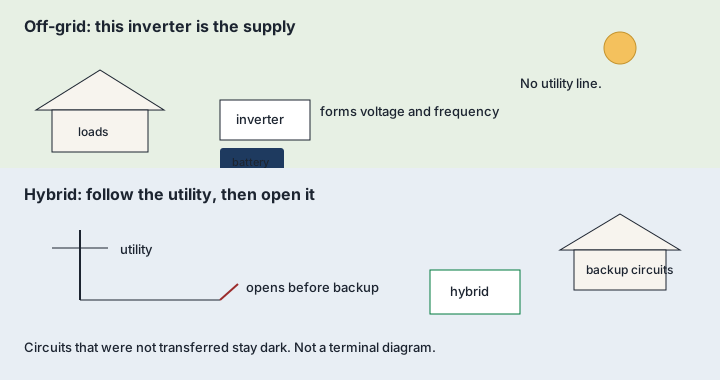
What an off-grid inverter is responsible for
It creates voltage and frequency from the battery. The modules do not create that waveform. They recharge the battery through a charge controller or through a solar input on the inverter, if the inverter has one. Remove the battery and a normal off-grid inverter stops, even in strong sun. That limit is in can an off-grid inverter work without a battery. Sizing is about continuous watts and motor surge, not about the module nameplate: how to size an off-grid inverter.
The waveform is a real choice here, because this inverter is the grid. Pure sine versus a stepped approximation matters to motors and to some chargers. A grid-tied inverter does not offer you that choice. An off-grid inverter does, and a blank datasheet is not pure by default. The difference is in pure sine wave versus modified sine wave.
A generator can be the second source for long cloudy weather. It has to charge through a listed path or feed loads through a transfer that never ties two unsynchronized sources together. No wiring diagram is given for that. The decision is in using a generator with off-grid solar.
What a hybrid inverter is responsible for
While the grid is up, it synchronizes and may charge or discharge the battery. IEEE 1547-2018 requires it to cease energizing an unintentional island within 2 seconds. Ride-through and other grid-support functions do not cancel that rule. When the grid fails, a hybrid that has backup mode opens the utility connection and then forms a supply for the circuits on the backup side. Circuits that were not transferred go dark. That is a design, not a disappointment, unless the quote promised the whole building and the panel contains one room.
A hybrid without a battery may be willing to run as an ordinary grid-tied inverter. It is not an off-grid inverter in that state. The comparison with a plain grid-tied unit, which is a different purchase from this one, is in hybrid inverter versus grid-tied inverter. Three-phase versions exist for three-phase services. They are not a house default: what a three-phase hybrid inverter is.
Hybrid inverter versus off-grid inverter
| Question | Off-grid inverter | Hybrid inverter |
|---|---|---|
| Is there a utility? | No. The inverter is the supply. | Yes, when the grid is up. The inverter follows it. |
| Battery | Required for a house. The DC source the inverter forms from. | Required for backup and for shifting energy. Some units run grid-tied with no battery. Confirm the manual. |
| Outage | There is no utility outage to ride through. If the battery is empty, the site is down. | Backup only after disconnection, on the transferred circuits, while the battery holds. |
| The mistake to avoid | Tying the output to a live utility service. | Expecting off-grid behavior in a cabin that has no grid and no battery. |
Voltage class is shared. The battery bank has to sit in the inverter’s DC window, whether that window is 24 volts or 48 volts. Current and cable loss change with that choice: 24 volts versus 48 volts. Service voltage on the AC side is not shared. An off-grid inverter is set to the appliances you own. A hybrid is set to the utility you interconnect with. Those can be the same numbers. They are not the same decision.
Life and maintenance do not pick the column. Heat, dust, and overload age both machines. Warranty years are contracts. How people over-read those years for off-grid units is in how long an off-grid inverter lasts. A hybrid on a grid-tied wall often spends more hours at light load and still has to survive hot afternoons. Neither story is “buy the other type and it will last longer.”
If the site has utility power today and might not in a future outage, the hybrid column is the one that can be interconnected and can still island after a listed disconnect. If the site has never had a service drop, the off-grid column is the honest machine. Buying both, or buying the hybrid and then refusing to read the off-grid section of its manual, is how cabins get equipment that will not start. Settle the utility question on paper before the crate is ordered.
Frequently asked questions
Can I use an off-grid inverter in a house that has utility power?
Not connected to the utility wires. An off-grid inverter forms its own supply. If you want solar and the utility, start with a grid-tied or hybrid inverter the utility will interconnect. A transfer scheme that islands the off-grid inverter is a listed design, not a double socket.
Can a hybrid inverter run a cabin with no utility?
Only if the manual has an off-grid mode, a battery is installed, and you accept that you paid for grid functions you will not use. Many hybrids expect a grid to start or to charge. Read that section before you haul the unit to a site with no service drop.
Which one is better for outages in a city?
The hybrid, or another listed backup system, because the city house has a utility that must be disconnected before any island is formed. An off-grid inverter is the wrong default for that house. It is the right default for a site that has no utility at all.
Sources and references
Cease-to-energize within 2 seconds on a grid-connected inverter: NREL and Sandia, IEEE 1547-2018 primer. Inverter thermal stress follows dissipated power and cooling path: Sandia and NREL thermal study. No ranking of brands and no preferred kilowatt size are stated.
