
- What 24 volts and 48 volts change
- Cable current, and what the voltage does not choose
- A practical way to pick
- Frequently asked questions
- Is a 48-volt solar system more efficient than 24 volts?
- Can I wire two 24-volt batteries in series for 48 volts?
- Does 48 volts mean I can use thinner wire everywhere?
- Sources and references
A 24-volt solar battery bank and a 48-volt solar battery bank store energy at different voltages. For the same power, the higher voltage draws less current. Less current means less loss in the cables and smaller wire for the same run, if the insulation and the overcurrent protection are chosen for that circuit. It does not mean 48 volts is always the better house. The inverter, the charge controller, and the appliances that run on DC all have to be built for the voltage you pick. A 24-volt inverter on a 48-volt bank is the wrong machine, not a free upgrade.
What 24 volts and 48 volts change
Power is voltage times current. Double the voltage and the current for the same watts is cut in half. A 1,000-watt load at 24 volts is a bit over 40 amps on the DC side before you count inverter loss. The same 1,000 watts at 48 volts is a bit over 20 amps. Those are arithmetic, not a product rating. The cable, the fuse, and the inverter’s DC terminals have to be rated for the current you actually have, including surge. This page will not give a wire chart. The chart in the inverter manual, for that distance and that current, is the one that counts.
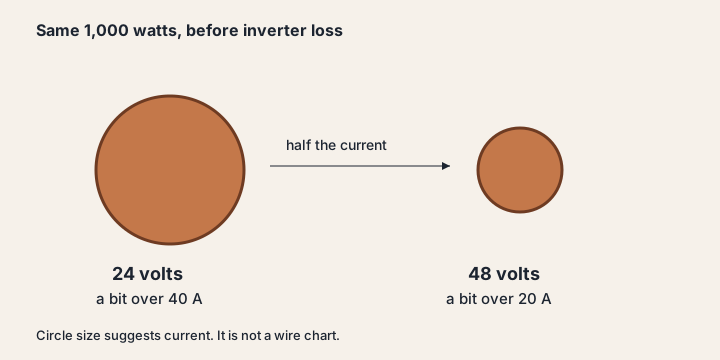
Loss in a cable rises with the square of the current for a given resistance, so cutting the current does more than “a bit” for a long run between the battery and the inverter. A short run beside the battery sees less of that benefit. People who put the inverter next to the bank and then argue about 48 volts as if the cable were 30 meters long are solving a problem they did not build. Measure the run. Then choose.
The battery’s own voltage has to match. Four 12-volt blocks in series are a 48-volt string if they are the same type and they are wired as a series string. A lithium iron phosphate pack built as 16 cells in series sits near 51.2 volts nominal, which is the usual “48-volt class,” not a 48.0-volt flat line. The inverter’s DC window has to include the full charge voltage and the low cutoff. A window copied from a lead-acid 48-volt bank may not fit that lithium pack. Chemistry and nominal class are in why LFP batteries are used for solar storage. Do not series extra cells to “make” a voltage the inverter was not listed for.
Cable current, and what the voltage does not choose
It does not decide how many hours you can run. Hours come from usable watt-hours, which is the battery’s energy, the depth you are allowed to use, and the load. A small 48-volt pack can store less than a large 24-volt bank. Voltage is not capacity. Kilowatt-hours are printed on the battery sheet, or they are voltage times amp-hours, and you still have to apply the usable fraction the manufacturer allows. There is no universal depth of discharge in this article.
It does not decide safety by itself. Both voltages are above the “touch it casually” line in a wet battery room, and both can weld a tool across the terminals. Higher voltage is more demanding of insulation and of the rating marked on the charge controller’s PV input, but a short on a high-current 24-volt bank is not gentle. The maintenance rules stay with the chemistry: solar battery maintenance.
It does not let you skip the charge controller. A 48-volt bank still needs charge voltages set for that bank. An MPPT controller is often the practical match, because module strings are rarely at 24 or 48 volts at their power point. PWM wants a matched array. The distinction is in what a solar charge controller is. Cold open-circuit voltage still has to sit under the controller’s maximum, whichever battery voltage you chose.
Off-grid inverters are built for a stated DC voltage. The forming inverter will not “accept either.” If you are still deciding whether you need a battery at all, settle that first: can an off-grid inverter work without a battery. The answer is no for a house. The voltage choice comes after that answer.
A practical way to pick
| Site | Why the voltage comes out the way it does |
|---|---|
| Small 12-volt loads already in the cabin | A 12-volt bank can be honest. Jumping to 48 volts means a converter for those loads, which is its own loss and its own failure point. |
| A house inverter of several kilowatts, battery not in the same cupboard | 48-volt class cuts the DC current and the cable loss. The inverter and the controller must be 48-volt class too. |
| An existing 24-volt inverter you are not replacing | Stay at 24 volts. A new 48-volt battery does not fit that inverter. Replace the pair together if you change. |
Series strings of batteries have to be matched. Mixing old and new blocks in one series string unbalances the charge. Parallel strings have to be the same voltage. A 24-volt string paralleled with a 48-volt string is a short, not a bigger bank. If you are unsure which way the cables go, stop and get someone who wires battery banks for a living. The array is live in daylight, and the battery can deliver fault current with the array disconnected.
Frequently asked questions
Is a 48-volt solar system more efficient than 24 volts?
The DC cabling loses less at the lower current, especially on a long run. Inverter efficiency is a separate number on the datasheet and is not guaranteed to be higher because the battery is 48 volts. Do not add a cable saving you have not calculated to a brochure efficiency and call it the system.
Can I wire two 24-volt batteries in series for 48 volts?
Only if they are the same type, the same age and state, and the inverter and controller are listed for 48 volts. Two mismatched batteries in series do not make a clean 48-volt bank. The charge controller has to be reset to the new voltage. Leaving a 24-volt profile on a 48-volt string overcharges or never finishes the charge.
Does 48 volts mean I can use thinner wire everywhere?
Only on the circuit whose current actually fell, and only if the manual’s ampacity and voltage-drop limits say so. PV source circuits follow the module current, which did not change because the battery did. Do not rewire the roof with a battery rule.
Sources and references
The current relationship used here is the definition of electrical power, voltage times current. No cable table is printed, because a safe wire size depends on the current, the length, the insulation, and the code that applies at the site, none of which is universal. Controller behavior when array voltage and battery voltage differ: Victron, PWM or MPPT. A 16-cell lithium iron phosphate string is described as a nominal 48-volt class near 51.2 volts because that is 16 times the usual 3.2-volt LFP cell nominal. Confirm the pack voltage on the battery you buy. Live DC work stays with trained people: Pacific Northwest National Laboratory.
