
- The stop protects people working on the line
- Backup is a listing, not a mood the panels have
- Critical circuits and a whole house are different sums
- How to tell which system was installed
- What you can check without opening a DC connector
- Frequently asked questions
- If I add a battery later, will the panels work in the next outage?
- Why did my neighbor's solar stay on?
Grid-tied solar panels do not run a house through a utility outage. The inverter follows the grid. When utility voltage disappears, that inverter stops delivering power so it does not energize a line that lineworkers are treating as dead. The modules can be in full sun. The house still goes dark. If the lights stay on, something else is carrying them: a listed backup mode, a battery on a backed-up panel, or a generator with a proper transfer. The panels by themselves are not that something else.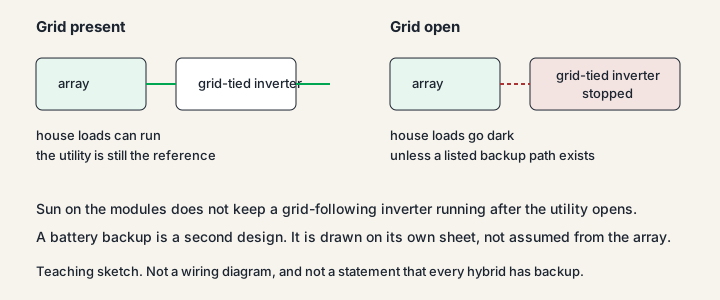
The surprise is reasonable. The array is on the roof, the sun is out, and the only thing that changed is a fault down the street. From the inverter's point of view the thing that changed is its reference. Grid-following equipment makes current that fits the voltage and frequency it is given. Take the voltage away and there is nothing to fit. The stop is the designed result, not a defect you clear by restarting the inverter.
The stop protects people working on the line
The behavior is called anti-islanding. An island, in this sense, would be your inverter keeping a section of the utility network energized after the utility has opened it. Lineworkers, and neighbors' equipment, are exposed if that happens. The long account of what the protection is for, and of how the United States interconnection standard treats it, stays in what anti-islanding is. This page does not restate a timing figure from a page that was not available to re-read. The consequence is enough: a normal grid-tied array is not an outage plan.
Cycling the AC disconnect, pulling a breaker, or waiting for the app to refresh does not create a reference the utility has removed. When the utility returns and stays inside the inverter's allowed window, the inverter may reconnect on its own, after whatever delay its settings require. That reconnection is a return to complementary operation. It is not proof that the inverter was able to carry the house during the gap. What a grid-complementary solar system does is the architecture that depends on the utility being present.
Backup is a listing, not a mood the panels have
A hybrid inverter can support selected loads during an outage only when it is listed to form an isolated supply, or to transfer onto one, and only for the circuits on that backup path. Some products sold as hybrids do not include that mode. The listing question, including why a battery voltage that looks familiar is not enough, is in can a hybrid inverter work without the grid. An off-grid inverter is built to form voltage from the start, which is a different purchase from adding panels to a grid-tied house. Grid-tied versus off-grid keeps the architectures from being averaged together.
The battery has to be part of that listing, not an accessory assumed to "kick in." A pack that was installed only to shift a tariff may have no transfer switch, no backed-up panel, and no reserve. It can be full at the moment the grid fails and still unable to feed a single socket, because nothing in the system is allowed to form an island. Home battery backup for outages is where that equipment list is developed. A battery for the bill versus a battery for an outage is why a pack emptied for the evening rate may also be empty when the outage starts, even if the transfer exists.
Critical circuits and a whole house are different sums
Backup energy is running watts multiplied by hours, on the circuits that actually transfer. A refrigerator, a router, a few lights, and a gas furnace's controls are one sum. A house that also keeps the oven, the dryer, the well pump, and the air conditioner is a much larger sum, and many home batteries were never sized for it. The method for writing the small list honestly is in sizing backup for critical loads. Starting from "the whole house" and then discovering the battery lasts twenty minutes is how that method gets skipped.
Solar can extend a backup day only on the circuits the island is allowed to feed, and only while the forming inverter is running and the array is inside that inverter's input limits. A grid-tied string inverter that has already ceased to energize does not start contributing midway through the outage because the clouds parted. If a second inverter, or a hybrid input, is listed to use the array during the island, that path has to be on the one-line. Sun on unused modules is not extra backup.
How to tell which system was installed
| What you can see | What it suggests | What it does not prove |
|---|---|---|
| One inverter, no battery, production dies with the street | A grid-following system | That a hidden backup mode exists in a menu you have not opened |
| A battery and a separate backup panel with a few breakers | A critical-loads design | That every circuit in the main panel is on that list |
| A battery, and every circuit goes dark in an outage | Storage without a transfer onto an island | That the battery is faulty. It may have no permission to form voltage |
| A generator inlet and an interlock or transfer switch | A generator path that can be isolated from the utility | That the generator may be plugged into an ordinary outlet |
The one-line diagram is the document that should match the wall. Array, inverter, battery if any, both disconnects, and the backup panel if any, each appear once. How to read that sheet is in how to read a solar one-line diagram. If the wall has a battery the drawing does not, or the drawing has a backup panel the wall does not, you do not yet know which outage behavior you bought.
A generator used as the second source has its own rules. It must not energize the utility. The inlet, the transfer, and the reason a battery usually stays in an off-grid design are in a generator with off-grid solar, without a wiring sequence. Exhaust and carbon monoxide stay in the generator manual. Owning solar equipment does not teach those hazards.
What you can check without opening a DC connector
During an outage, look at which panel still has power, if any, and at the inverter's stated mode if the screen is alive. Write down the time, whether the sun is on the array, and which circuits work. That note is useful to the installer. Pulling MC4 connectors, measuring string voltage, or tying a portable power station into a wall socket is not. Modules remain a live DC source in daylight even when the inverter has stopped. The safe observation is the one that does not open a conductor.
After the utility returns, confirm that production resumes and that any backup reserve is back at the setpoint you agreed. A system that carried the lights is a system whose listing, transfer, and load list were designed for that. A system that went dark in the sun is behaving as grid-tied equipment behaves. The second outcome is not a failed array. It is the protection doing what it was installed to do.
Frequently asked questions
If I add a battery later, will the panels work in the next outage?
Only if the added equipment is listed to form or transfer an isolated supply and the circuits you care about are on that supply. A battery tied to a grid-tied inverter for tariff shifting does not create backup by its presence. Ask for the backup mode on the inverter sheet and for the panel schedule that transfers.
Why did my neighbor's solar stay on?
Their system is probably a different listing: a hybrid in backup mode, an off-grid inverter, or a generator. Sun on both roofs does not mean both inverters are allowed to run without the utility. Compare the equipment, not the weather.
