A solar street light that is dim at 9pm is often doing what the controller was told to do. The controller is the box that charges the battery by day, decides that dusk has really arrived, and then spends the night rationing whatever charge is left. Replacing the LED before you read the state of charge fixes the wrong part.
Updated October 2026. Voltages and enclosure ratings below are taken from particular product sheets. They are examples of the job, not a rating every controller has.
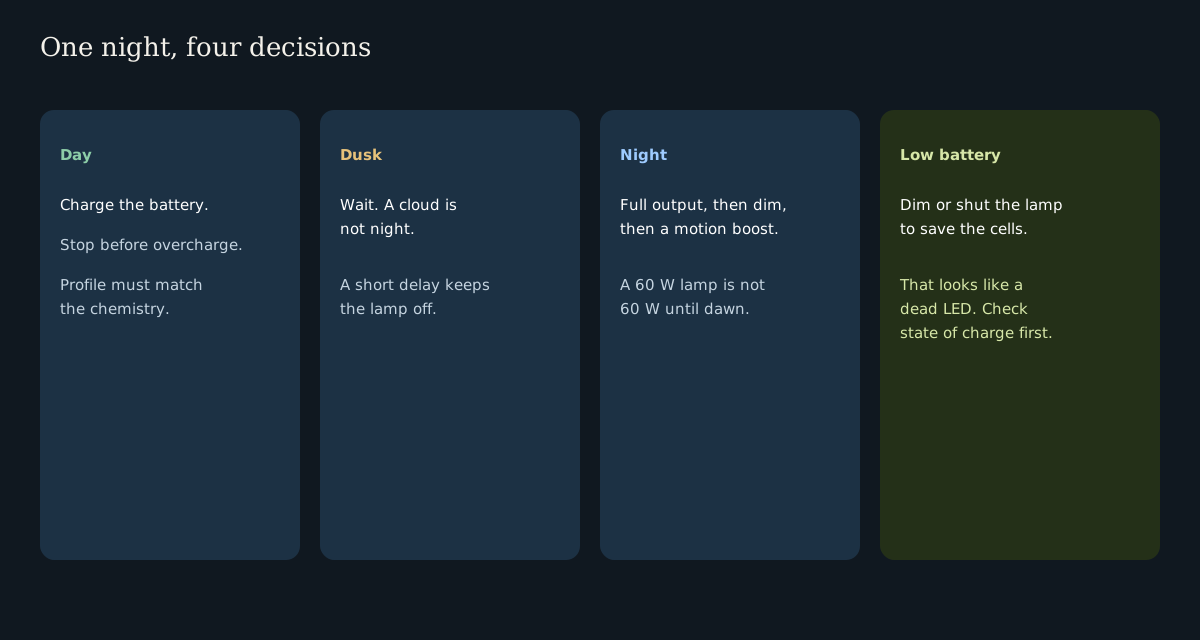
Daytime is a charge profile, and the chemistry has to match
While the sun is up, the controller’s job is to put current into the battery and stop before it is damaged. The voltages are not universal. A Phocos CIS-N-LED datasheet written for lead-acid lists a float near 13.8 V on a 12 V system, a boost and an equalisation stage, and temperature compensation. Those numbers will overcharge or undercharge a lithium iron phosphate pack. A Lumiax street-light controller sheet aimed at lithium cells instead exposes a programmable charge voltage, a low-voltage disconnect, and a choice to block or slow charging at 0°C. Cold charging is how lithium cells get plated. If the pole uses a replaceable lithium pack, the controller has to know that, in its settings, not only on the purchase order.
Maximum-power-point tracking is a method of taking more from the module as light and temperature move. It is not a licence to print a percentage gain on a tender. Ask whether this controller does it, at what panel voltage, and whether the battery voltage is inside its charging window. A tracker that cannot charge because the battery is full, or too cold, is behaving.
Dusk needs a pause
The module is the light sensor. When its voltage falls through a threshold, the controller treats that as sunset. A cloud does the same thing for a minute. Controllers built for street lights therefore wait. E-Lite’s Talos description uses a programmable delay, on the order of minutes, so a passing cloud does not cycle the lamp. Lumiax’s lithium sheet lists a day/night delay that can be set from 0 to 30 minutes. Set the delay to zero and the lamp will blink in broken weather. Set it very long and the road stays dark after sunset. The right value is a site choice, and it should be written down, because the next technician will otherwise “fix” it.
The night is a schedule, so the nameplate watts are a ceiling
After the delay, the controller runs a programme: full output for the early evening, a lower level through the quiet hours, sometimes a rise again before dawn, and a short return to full output if a motion sensor trips. The Phocos sheet describes that pattern as a timer plus dimming, with a motion input that overrides the dim and holds full brightness for a time set on the sensor. Five-stage dimming on other street-light controllers is the same idea with more steps.
A lamp sold as 60 W is 60 W only while the programme says 100%. If it spends six hours at 30%, the battery sees something closer to a 20 W load for those hours, plus the full-power intervals. Anyone who sizes the panel and the battery from “60 W times 12 hours” will buy a bank that is larger than the programme needs, or will be confused when a correctly dimmed light looks “weak” next to a neighbour that was left at full output and dies at 2am.
A dim lamp is often battery protection
When voltage falls, a street-light controller is supposed to give up light to keep the cells alive. Phocos calls this an auto-protect: two low-voltage levels, and the LEDs dim as charge drops, with the levels programmable. Lumiax allows a dimming start voltage and a percentage, and can cut the lamp off at a low-voltage disconnect. The pole looks faulty. The battery is low because the week was cloudy, the panel is shaded or dirty, or the night programme is longer than the winter day can refill.
The useful check is state of charge or battery voltage at dusk, then panel current at noon, then whether the dimming table matches the road’s actual hours. Swapping the LED head first throws away that evidence.
What belongs on a maintenance card
- Battery chemistry, and the charge voltages set for it.
- Dusk threshold and delay.
- The dimming table, hour by hour, and what motion does to it.
- The voltage at which the lamp dims, and the voltage at which it switches off.
- Whether the enclosure rating is this model’s rating. IP68 on one encapsulated lead-acid controller is not a promise about the next box.
Sheets these examples come from
Lead-acid charge stages, timer, dimming and low-battery dim on one LED controller: Phocos CIS-N-LED series datasheet (charge controller, timer and LED driver in one IP68 case, specified for lead-acid). Lithium setpoints and a 0 to 30 minute day/night delay: Lumiax Smart-DC lithium street-light controllers. A readable description of the cloud delay and of dusk-to-dawn versus motion programmes: E-Lite Talos controller notes. Copy the behaviour, then set the numbers from the controller that is actually on the pole.
