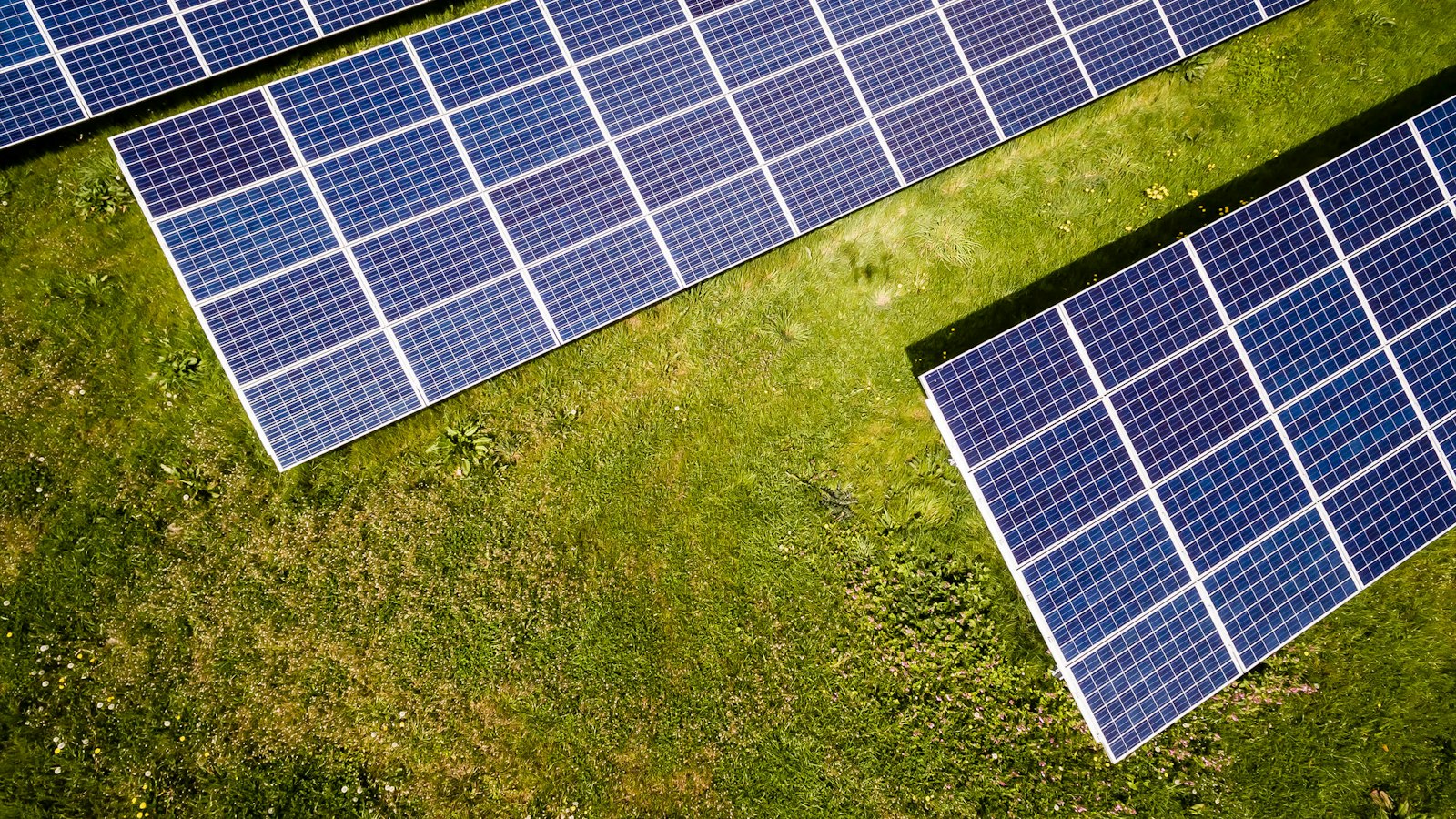
Solar panels on a cloudy day still produce electricity. They produce from the light that reaches them, and on a cloudy day most of that light is diffuse light from the sky rather than the direct beam. They do not produce their nameplate, and there is no single percentage of nameplate that this article can honestly give you. A “10 to 25 percent” rule that floats around the web was not in the measurements opened for this page. If your monitoring says something else, believe the monitoring for your array and your cloud, not a round number from somewhere else.
What light solar panels use on a cloudy day
Light on a module is three parts: the beam from the sun’s disk, diffuse light from the sky, and light reflected from the ground. NREL’s shade work treats those parts as separable. An obstruction such as a tree blocks the beam on the cells it covers and leaves diffuse and reflected light in place. A cloud does something broader. It scatters the beam before it arrives, so the array sees a bright or a dim sky instead of a disk. The whole array is affected, not one module under a vent. That is why a cloudy day and a shaded string are different faults, and why a shade study will not tell you the cloudy-day number. Shade, which is local and nonlinear, is in how shade affects PV output.
Nameplate watts are not a cloudy-day promise. The efficiency tables measure cells and modules under a global AM1.5 spectrum at 1,000 watts per square meter and 25°C. A thick overcast is far below 1,000 watts per square meter. Output falls because the irradiance fell, not because the panel “does not work in cloud.” Thin cloud can still be a high-irradiance hour. Thick cloud can be a very small one. The inverter’s log, next to a weather note, is the record. A portal that only shows a daily total hides whether the day was cloud or a fault.
Temperature can move the other way. Cloudy hours are often cooler cells. The module’s temperature coefficient then takes less away than it does on a hot clear afternoon. You can have a clear afternoon that looks disappointing against the nameplate because the cells are hot, and a bright cloudy hour that looks better than you expected because they are cool. Neither hour is the standard test. Heat is in how heat affects a solar module.
What a cloudy day is not
It is not snow on the glass. Snow is a cover. NREL’s snow model treats new snowfall as full coverage and finds fixed-tilt annual losses from about 0 to 16 percent of yearly energy across the continental United States for the tilts it mapped, which is a year-long figure, not a description of one cloudy Tuesday. Snow and cloud can happen together. They are still different. See snow on solar panels.
It is not a dead string. A cloudy day pulls every string down together, in proportion to the light, if the array is uniformly exposed. One string at zero while the others track the cloud is a fuse, a connector, or an inverter input. Soiling is slower than a cloud. It does not arrive at 10 a.m. and leave at noon. If you are deciding whether to wash, do not use a cloudy day as the before-and-after. The wash decision is in how to clean solar panels.
It is not a reason to expect night-time power. When the diffuse light is gone, production is gone. A battery can carry the load if it was charged earlier. The modules cannot. Off-grid design has to include a run of cloudy days as a battery and generator problem, not as a hope that diffuse light will be “enough.” How large that bank is remains a site choice. The chemistry for a daily cycle is a separate choice, in why LFP batteries are used for solar storage. Grid-tied homes simply buy the cloudy evening from the utility, and the inverter stops if the utility is down. IEEE 1547-2018 still requires that stop within 2 seconds. Cloud does not create an islanding exemption.
How to read solar panels on a cloudy day
| What the log shows | Likely meaning |
|---|---|
| All strings down together, tracking the sky | Cloud. Diffuse light, not a fault. No universal percent of nameplate. |
| One string flat, others moving with the cloud | That string, not the weather. Do not wash it as a cure. |
| A hard notch at the same hour every clear day | Shade from an object. Cloud would not keep the same clock time. |
| Zero while the glass is covered in snow | Cover, not cloud. Different model, different safety rule. |
Pacific Northwest National Laboratory’s band of about plus or minus 10 percent around average insolation is a way to judge a sunny period, not a conversion factor for overcast. Use it to avoid sending a technician on a normal clear day. Use the string log to avoid calling a cloudy day a failure. If you are estimating a year, a weather file inside a tool such as PVWatts already contains cloudy hours for that location. Replacing that file with a homemade cloudy-day percentage double-counts or contradicts it. Sizing without a stock panel count is in how many solar panels a home needs.
Frequently asked questions
Do solar panels work on a cloudy day?
Yes. They convert the diffuse light that gets through. Output is lower because irradiance is lower than the 1,000 watts per square meter used for the nameplate. How much lower depends on the cloud and the site. There is no single percentage.
Is a cloudy day the same as shade?
No. Shade is a nearby object blocking the beam on part of the array. Cloud replaces the beam with diffuse light across the array. The electrical result of a small hard shadow can be worse than the shadow’s area. A uniform cloud does not do that.
Should I turn the system off when it is cloudy?
No. It is still producing, and the inverter is built to run at low power. Turning it off adds zero and saves nothing important. Leave it. Look at the log if one part of the array stops while the rest follows the sky.
Sources and references
Beam, diffuse, and reflected components, and why shade is not a uniform derate: NREL and University of Colorado shade database. Nameplate test conditions of global AM1.5, 1,000 W/m², 25°C: Green and colleagues, efficiency tables version 68. Insolation varying about ±10 percent, which is not a cloudy-day factor: Pacific Northwest National Laboratory. Snow cover as its own loss: NREL snow model. Islanding limit, unchanged by weather: NREL and Sandia IEEE 1547-2018 primer.
