- Name the job before you compare kilowatt-hours
- A night of essentials is a small load until the oven joins it
- Backup is a panel, not a mode in an app
- Holding energy back for a rare outage has a bill
- The 2026 price pages do not describe one market
- Frequently asked questions
- Does a home battery run the whole house in a blackout?
- Will my existing solar keep producing during an outage if I add a battery?
- Is a bigger kilowatt-hour pack always the safer buy?
- Notes
A residential energy storage system is a home battery, usually paired with solar, that holds daytime electricity for later. The useful size is not a single number. It depends on which job you buy first: shifting solar into the evening, or keeping a short list of circuits alive in a blackout. Those two jobs ask for different kilowatt-hours, different power ratings, and often extra hardware that a grid-tied battery does not include.
Updated October 2026. Prices below are other publishers’ 2026 snapshots. They do not agree, and none of them is a quote for your street.
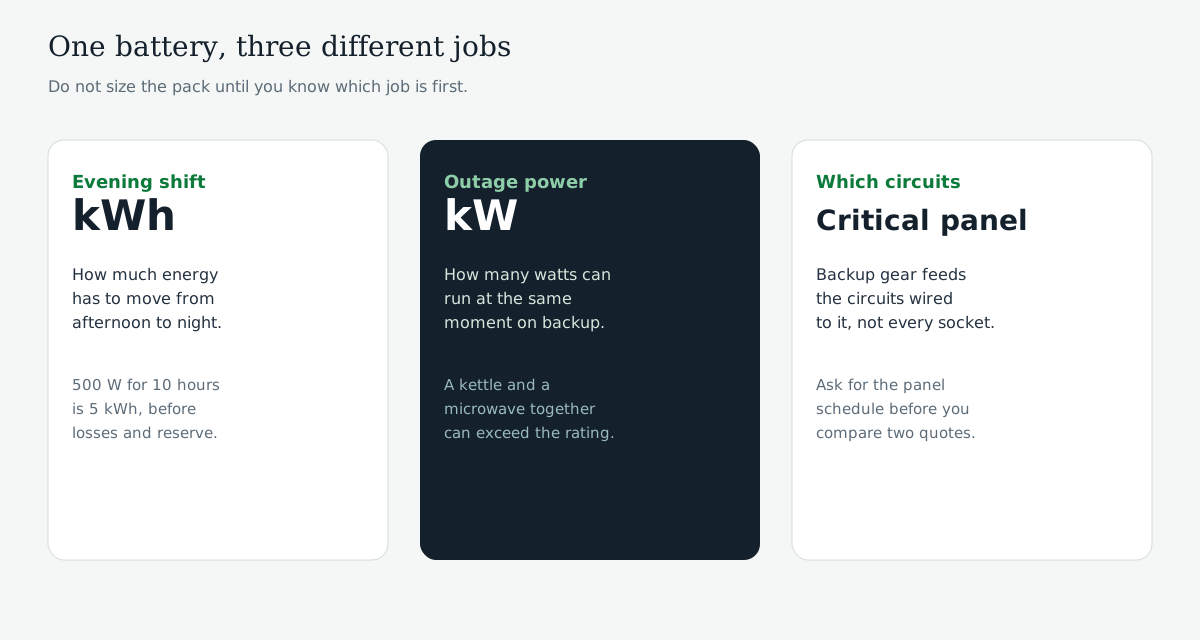
Name the job before you compare kilowatt-hours
Pacific Gas and Electric describes four ways a home battery is actually used: backup during an outage, shifting use away from expensive hours, running as much of the house as possible on solar, and joining a grid program. A single pack can be set to more than one of those, but the setting changes how much energy is left when the lights go out. A battery kept full “just in case” is a poor bill-saving battery. A battery emptied every evening is a poor backup.
Write the job in one line before you read a brochure. “Cover the evening peak on a time-of-use tariff” is a different purchase from “keep the fridge, the router, and a few lights on for a night.” If the quote does not say which one it was drawn for, the kilowatt-hour figure is decoration.
A night of essentials is a small load until the oven joins it
Powertrusted, reading a set of current home-battery ranges, puts a night of essential circuits at roughly 5 to 10 kWh when the house is drawing about 500 watts. Their own product set had a median starting capacity of 9.6 kWh, and about half of the ranges they listed began somewhere between 5.12 and 14.4 kWh. That is a catalogue, not a rule. It is still a useful check against a quote that opens at 20 kWh because the sales sheet did.
Do the arithmetic in the other direction. A fridge, a router, a few LED lights and a laptop can sit near that 500 watt band. A kettle is often 1.5 to 3 kW for a few minutes. An electric oven is in the same neighbourhood while it is heating. The energy (kWh) of a short cooking burst is modest. The power (kW) is what trips a small backup inverter. If the household expects to cook during an outage, say so. If it does not, do not pay for a whole-home rating to keep a router alive.
EnergySage’s 2026 buyer guide treats 10 to 15 kWh as a common band for essential loads, and notes that a full day of whole-home backup is a larger project. The spread between “5 to 10” and “10 to 15” is not a contradiction you need to average. One page is describing a night at low power. The other is leaving room for a bigger essential list. Your list decides.
Backup is a panel, not a mode in an app
PG&E is plain about this: backup usually means selected circuits, not the whole house. Islanding, the moment the house disconnects and keeps running, needs equipment that a plain grid-tied solar inverter does not have. In a blackout, ordinary grid-tied solar stops. The battery does not automatically take over unless the system was built to do that, and unless those circuits were moved onto the backup side.
Ask for the circuit list on paper. Fridge, well pump, medical device, broadband, a lighting circuit, maybe a gas boiler’s controls. A well pump or a medical device can dominate the power rating even when the nightly energy looks small. Two quotes with the same kilowatt-hours and different circuit lists are not the same system.
Holding energy back for a rare outage has a bill
A battery reserved for blackouts spends most days not doing the job that pays the bill. Berkeley Lab looked at that tradeoff in ten US locations. The reliability value of a higher reserve was, in their words, surprisingly insensitive to how much capacity you held back, while the bill savings fell as the reserve rose. In most of the cases they ran, the savings you give up outweigh the reliability you gain. The exception they describe is narrow: very poor reliability, a high personal cost of an outage, and a tariff where the price gap is modest. That is not an argument against backup. It is an argument for being honest about how often the power actually fails, and for sizing the reserve to the circuits that matter rather than to the whole board.
If outages are rare and short, a smaller pack on a critical panel can be the rational buy, and the rest of the solar can keep cutting the daytime bill. If outages last days, the conversation moves to how the battery recharges while the grid is down (the solar has to be allowed to run in island mode) and whether a generator is the cheaper way to cover day three. A bigger lithium pack is not automatically the answer to a three-day storm.
The 2026 price pages do not describe one market
Storage is still the smaller part of new US rooftop solar. Berkeley Lab’s Tracking the Sun found that 12% of new residential PV systems in its 2023 sample included a battery. Enphase’s homeowner guide puts the same year at 13%, and says that share had tripled since 2018. Hawaii and, late in 2023, California’s new net-billing tariff sat far above those national figures. A national average will not tell you whether a battery pays on your tariff.
Do not average the price pages below. They are different samples, and the tax rule is a US rule.
- Solar.com, using its installer network, published an installed range of about $6,000 to $18,000, near $1,300 per kWh before incentives. The same page says the 30% credit for a battery the homeowner buys ended for systems installed after 31 December 2025, and that a 2026–2027 credit, as they describe it, remains for leases, power-purchase agreements and prepaid contracts.
- The IRS page on the Residential Clean Energy Credit is the part to read before a contract: the credit is not available for property placed in service after 31 December 2025. Battery storage of at least 3 kWh was on the qualified list while the credit existed.
- EnergySage’s marketplace, first half of 2026, puts a typical 13.5 kWh battery at $15,647 installed before incentives. Their buyer guide also says many households looking only at essential loads land in a 10 to 15 kWh band, and that the headline price should itemise the panel work.
A leased battery and a purchased battery are different products once a tax credit attaches to only one of them. Outside the United States this paragraph does not set the price at all. Australia, Germany and the UK have their own rebates, and a US dollar-per-kWh line will mislead a buyer in Lagos or Manila. Ask for an installed price that includes the gateway, the critical panel, permits and the warranty terms, not a cell price.
Frequently asked questions
Does a home battery run the whole house in a blackout?
Usually no. Utilities and installers design backup around a list of circuits. Whole-home backup needs enough power for the large appliances and enough energy for the hours you care about. Many quotes do the first job and describe it as the second.
Will my existing solar keep producing during an outage if I add a battery?
Only if the new system is allowed to island and to keep the solar running while the grid is down. A battery added only for bill shifting can still shut the solar off in a blackout. Ask that question in those words.
Is a bigger kilowatt-hour pack always the safer buy?
No. Extra energy that you hold in reserve does not cut the bill, and extra power you never use still has to be installed, permitted and warranted. Match the pack to the circuit list and to how often you actually lose the grid.
Notes
PG&E on backup circuits and the four operating modes: residential battery storage. Powertrusted’s capacity bands: home battery sizes. Berkeley Lab attachment rates: Tracking the Sun update. Enphase’s 13% line: essential guide. Solar.com’s price note: solar battery price. IRS on the credit end date: Residential Clean Energy Credit. EnergySage’s 13.5 kWh figure: battery cost, and the 10 to 15 kWh band: how to get storage. Berkeley Lab on reserves versus bill savings: reserve study.
